When we decided to go on holiday in Réunion, we expected a change of scenery, but not this much. Every day was a discovery: incredible landscapes, hikes that make you feel at the end of the world, and above all a special atmosphere. If you are looking for Reunion Island holidays that combine discovery, relaxation and a change of scene, I can promise this is the right choice.
Crossing the island on the GR R2, we really had that feeling of adventure and of connection with nature. The feeling grew during the second part of our stay, with more chilled holidays. That is Réunion: an island where you can explore volcanoes, swim in waterfalls, walk through primary forests and end the day on a beach at sunset. In this article, I share what we lived, our tips, what to do in Réunion in 10 days and what not to miss, so your stay is unforgettable.
Sommaire
Reunion Island holidays at a glance
Réunion puts hikes, volcanoes, waterfalls and beaches within an hour’s drive of each other. The best period for hiking runs from April to October, during the austral winter. From November to March, it is cyclone season, so the weather can be unpredictable. A hire car makes everything easier, because public transport is limited. Our itinerary covers 10 days: lava tunnels, waterfalls in the south, Cilaos, the Piton des Neiges, the Piton de la Fournaise, Mafate, the west coast, the Maïdo and Salazie. Book your gîtes early, especially in Cilaos and Hell-Bourg.
Reunion Island holidays: why does this island make people dream?
Nature on a grand scale
Before arriving, we had seen photos and heard stories. But nothing prepares you for what you feel once you are there. The first time we saw the Piton de la Fournaise, we were simply speechless. And I am not even talking about the cirques like Mafate or Cilaos, where every trail leads to incredible scenery. For hiking lovers (or even for those who just want a gentle walk), Réunion is a giant outdoor adventure park. We loved alternating sporty days on trails like the Piton des Neiges with quieter moments discovering waterfalls like Langevin.
An impressive variety in just a few days
What struck me is how close everything is. In one hour’s drive, you can go from lunar landscapes on the volcano to a beach lined with filao trees. And what about the contrasts: a morning hiking in tropical forest. And the afternoon with your feet in the water at Boucan Canot. This variety makes Reunion Island holidays so special. There are so many things to do in Réunion, for every taste!
A culture that makes you travel
Of course, it feels a little less exotic, since we speak the language and still feel a bit at home. But the culture in the wider sense is truly rich. Between markets like the one in Saint-Paul (where we tasted incredible samosas) and chats with locals, every encounter taught us something. And then there is Réunion cuisine: spicy flavours, generous dishes like the curry (cari), and a habit of sharing everything. Honestly, it is one of those destinations where you quickly feel at ease, even as a tourist.
Why choose Reunion Island for your next holiday?
- Because it feels like a real change of scene without going too far.
- Because you can combine hiking, beaches, waterfalls and culture in a single trip.
- And above all, because it is an experience that stays with you.
How to plan your holidays to Reunion Island
When we started planning our holiday in Réunion, we quickly realised we needed a minimum of organisation to enjoy the island fully. Between the seasons, the accommodation and getting around, it is better to plan everything in advance to avoid bad surprises. Here is what we learned on the ground.
What is the best time to go to Réunion?
The first thing to know is that the island has two main seasons. If you want to hike or discover the cirques like Mafate and Salazie, the ideal period runs from April to October, during the austral winter. Temperatures are pleasant, there is less rain, and the trails are easier to walk. We went in October, and it was perfect for the GR R2: not too hot, with green landscapes. If you prefer a holiday focused on beaches and waterfalls, the period from November to March, during the austral summer, can also suit you. But be careful: it is the cyclone season, so the weather can be unpredictable.
The essentials to plan for your stay
- Car hire: Even if it is not totally impossible, it remains complicated to make the most of the island without a car. Public transport is limited, and many essential sites, like the Piton de la Fournaise or the Langevin waterfall, can only be reached by car. We hired a small car for our 10 days in Réunion (after our trek).
- Accommodation: There are many gîtes and guesthouses, but they fill up quickly, especially in areas like Cilaos or Hell-Bourg. Remember to book in advance, especially if you want to stay near the start of hiking trails.
- Climate and clothing: Bring enough to cover up for hikes at altitude (it can be cool on the summits), but also light clothes for beach days. Do not forget a good rain jacket: rain can come at any time, even in the dry season.

Things to do in Reunion Island
As I said above, the intense island is a huge outdoor adventure park for lovers of nature, hiking and stunning landscapes. Whether you enjoy physical challenges or more contemplative moments, this island offers a wide range of activities and places to discover. Here is a selection of the essential things to do on your holiday in Réunion.
Exploring the cirques of Réunion: Mafate, Salazie and Cilaos
The island’s three cirques are among its greatest natural wonders. Each has its own identity, and we took the time to explore several during our stay.
- Mafate: the authentic one
It is the wildest and most remote of the three. It can only be reached on foot or by helicopter. And it is perfect for hiking lovers and for a total disconnection. On the GR R2, we crossed the Cirque de Mafate via villages like La Nouvelle or Marla. Each hamlet invites you to slow down, with stunning mountain scenery all around. If you want to discover Mafate, plan at least a full day (we recommend spending a night or more) to enjoy this natural treasure. - Salazie: the kingdom of waterfalls
The cirque de Salazie is the greenest of the cirques. And it is easy to reach by car. Among the sites not to miss are the Cascade Blanche and the Voile de la Mariée, two impressive waterfalls. The village of Hell-Bourg, ranked among the most beautiful villages in France, is a charming stop. We found colourful Creole houses and small paths that immerse you in a timeless atmosphere. - Cilaos: between nature and relaxation
Cilaos is known for its thermal baths, its vineyards and its mountain scenery. It is also the most used starting point to reach the famous Piton des Neiges. The road to get there, with its 400 bends, is an experience in itself! Once there, you can hike the Roche Merveilleuse trail for a 360° panorama over the cirque, or simply relax in the thermal baths. Cilaos is the ideal place to combine effort and relaxation.

Admiring the volcanoes: Piton de la Fournaise and Piton des Neiges
The Piton de la Fournaise: a lunar hike
This active volcano is one of the absolute essentials of Réunion. Access to the Enclos Fouqué, this gigantic caldera, makes you feel as if you are walking on another planet. We got up at dawn to start the hike and avoid the heat. The climb to the summit takes about 5 to 6 hours return. But even a partial walk in this mineral landscape is already unforgettable. If you are (very) lucky, you may even witness an eruption, a rare and stunning show.
The Piton des Neiges: the roof of the Indian Ocean
At 3,071 metres, it is the highest point of the island and a legendary hike for trekking fans. We advise you to set off in the night to reach the summit at sunrise. From up there, the view over the three cirques (Mafate, Salazie, Cilaos) is spectacular. Bring good shoes and warm clothes, because it can be cold at altitude. You can sleep at the Piton des Neiges hut to do the climb in two stages.
Discovering the waterfalls of Réunion
The island’s waterfalls are everywhere, and each has its own charm. Here are some of our favourites:
Waterfalls are among the most beautiful natural wonders of Réunion. Here is a fuller selection to please nature lovers:
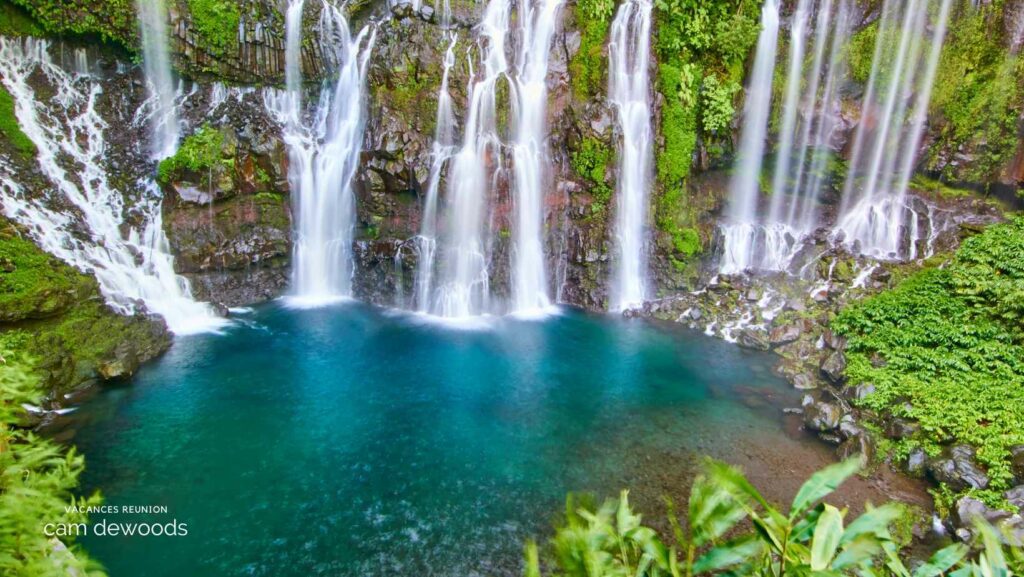
- Cascade Langevin (or Grand Galet)
Located near Saint-Joseph, this waterfall is easy to reach by car and remains one of the highlights of the south of the island. Its many threads of water falling into a pool make it a perfect place for a picnic or a refreshing swim. - Cascade de Takamaka (Bras-Panon)
Hidden at the bottom of the Takamaka valley, this waterfall is one of the most impressive on the island. But it can only be seen from developed viewpoints. Access to the valley is often damp, which makes the visit feel even more authentic. - Voile de la Mariée (Salazie)
Located in the cirque de Salazie, this waterfall is a true wall of water rushing down the mountain. Easy to reach by car, it is surrounded by ferns and lush vegetation, in a fairy-tale setting. - Cascade Blanche (Salazie)
At 600 metres high, this fall is one of the biggest in Réunion. It can be seen from several viewpoints in the cirque de Salazie and is worth the detour for panorama fans. - Cascade Bras Rouge (Cilaos)
This waterfall is reached by a hiking trail starting from the village of Cilaos. It offers a more sporty experience, but the reward is big: a wild setting and an impressive waterfall. - Trou de Fer (Bélouve)
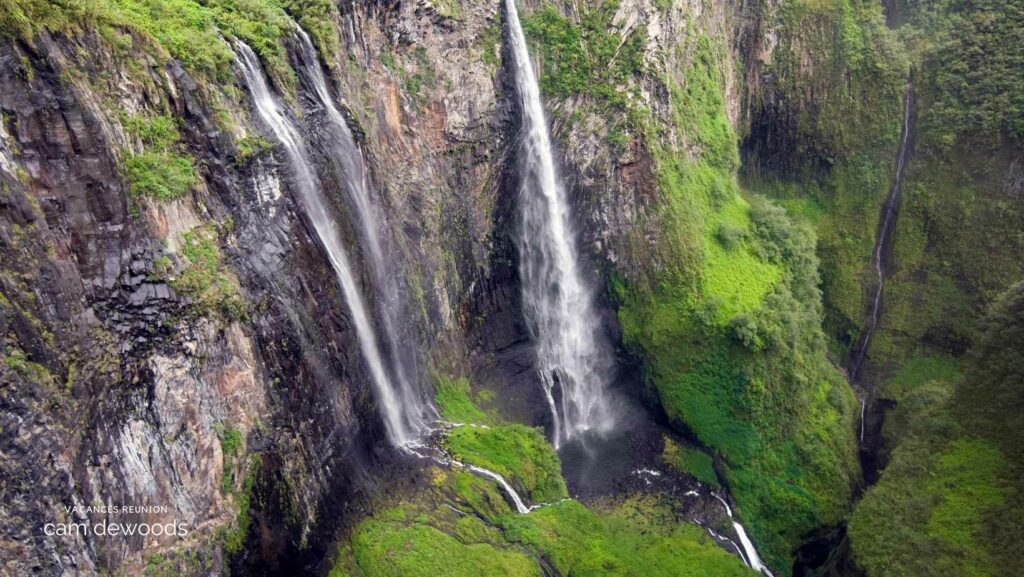
You cannot talk about the waterfalls of Réunion without mentioning the dizzying falls of the Trou de Fer. Although this site is mostly reached on a hike or by helicopter, it is an essential stop for nature lovers.
Enjoying the beaches and the lagoon
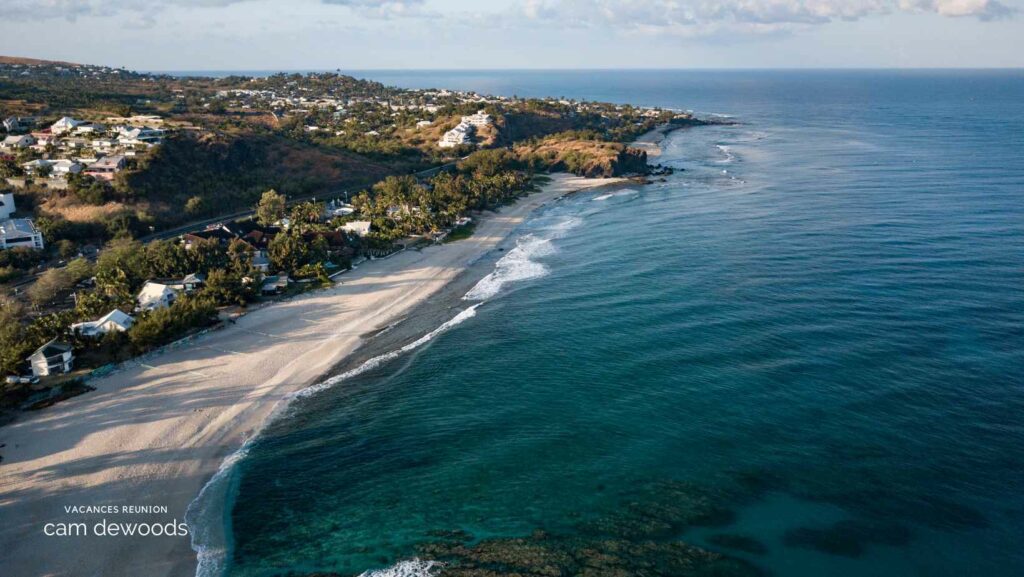
The beaches of Réunion are a perfect contrast after the hikes. Although you must respect the supervised areas because of shark risks, some beaches and lagoons are perfect for relaxing or exploring the seabed. Here is a full list of beaches not to miss:
- Boucan Canot beach
On the west coast, Boucan Canot is one of the most popular beaches on the island. It has a protective net for swimming, which makes it ideal for cooling off. With its golden sand and seaside restaurants, it is a perfect destination for a relaxing day. - Hermitage lagoon (Saint-Gilles)
This is the place for snorkelling. The lagoon is protected by a coral barrier, which makes it a calm and safe area to watch tropical fish. Grab your mask and snorkel, and get ready to dive into a real natural aquarium. - La Saline-les-Bains beach
Close to the Hermitage, this beach has the same advantages with a slightly more peaceful setting. It is an excellent option if you want to escape the crowds while enjoying the lagoon.
More beaches around the island
- Grande Anse beach (south of the island)
Near Saint-Joseph, this beach is beautiful, with filao trees that give shade. Although swimming is forbidden there, it is an excellent place for a picnic or a walk on the sand. - Trou d’Eau beach (La Saline-les-Bains)
This calm, less busy beach is ideal for paddleboard or kayak fans on the lagoon. - Étang-Salé
This black volcanic sand beach is special to Réunion. The atmosphere is different, with a striking contrast between the colour of the sand and the blue of the ocean. It is wilder, but perfect for a walk by the sea. - Manapany beach
This small cove in the wild south is lined with volcanic rocks. You can swim in a natural pool, and the setting is perfect for a quiet break.
Reunion Island holidays: what to do in 10 days? Our recommended itinerary
10 days in Réunion is perfect to enjoy the island to the full, with hikes, nature, waterfalls and moments of relaxation. Here is our detailed programme, based on our experience, with a few adjustments to offer you an even better itinerary.
Day 1: Saint-Denis and exploring the lava tunnels
👉 Morning: Pick up the hire car (recommended for getting around Réunion). Once ready, we headed south along the east coast. On the way, we stopped at Notre-Dame-des-Laves, a place full of history, with a church miraculously spared by a lava flow.
👉 Afternoon: Head to Saint-Philippe for an essential activity: caving in the lava tunnels. You explore the galleries formed by ancient eruptions. We loved this immersive activity, one of a kind.
Day 2: Waterfalls and swimming in the south
👉 Morning: We dedicated this day to the island’s iconic waterfalls. First stop at the Cascade Langevin, one of the most beautiful and accessible. We loved settling down for a picnic in the middle of nature. Then we headed to the Cascade Jacqueline, more discreet but just as pretty, ideal for a peaceful swim.
👉 Afternoon: A walk at the Marine de Vincendo, a wild place with a stunning view of the cliffs. If you prefer something more active, a walk on the coastal path is an excellent option to explore the south coast.
Day 3: Discovering Cilaos and its treasures
👉 Morning: After a night in Saint-Joseph, we left for the cirque de Cilaos via the famous road with its 400 bends. We took our time to enjoy the panoramas and make a few photo stops on the way. Once in Cilaos, the village charmed us with its colourful Creole houses, its thermal baths and its local market.
👉 Afternoon: A hike to the Chapelle, a fairly accessible walk with a lovely surprise in store!
Day 4: Grand Bassin hike
Day 5: Climbing the Piton des Neiges (optional)
For those who like a challenge, climbing the Piton des Neiges is essential. We chose to leave the evening before to sleep at the Piton hut (booking compulsory), then to get up at 3 am to reach the summit at sunrise. The effort is big, but the reward is worth it: a 360° view over the whole island.
👉 Alternative: If you prefer a more relaxing day, explore the trails around Cilaos, such as the Roche Merveilleuse trail.
Day 6: Exploring the Piton de la Fournaise
The Piton de la Fournaise is an essential stop in Réunion. From Bourg-Murat, we drove to the Pas de Bellecombe, the starting point of many hikes. We followed the trail to the crater, crossing fascinating lunar landscapes.
👉 Tip: Check the trail conditions before setting off, especially if there has been a recent eruption.
Day 7: The Cirque de Mafate, wild and preserved
Mafate is a special place, reached only on foot. We chose to start from the Col des Bœufs for a hike to the village of La Nouvelle. It is a total immersion in nature, with no road and no car, where time seems to stop.
👉 Advice: Plan to leave early to make the most of the day. Take water, snacks and a camera: the scenery is incredible!
Day 8: Beaches and relaxation on the west coast
After several days of hiking, we had earned a break. We headed to the west coast for a relaxing day.
👉 Morning: Swimming and snorkelling in the Hermitage lagoon, where the turquoise water and the colourful fish make you feel as if you are in a natural aquarium.
👉 Afternoon: We settled on Boucan Canot beach, perfect for resting while enjoying the waves.
Day 9: Sunrise at the Maïdo
For our second-to-last day, we got up very early to watch the sunrise from the Maïdo. This spectacular viewpoint over the Cirque de Mafate is an unforgettable experience. Then we spent the afternoon wandering around the local markets, which are perfect for bringing back a few souvenirs.
Day 10: Salazie and Hell-Bourg
The cirque de Salazie is a green haven, with waterfalls in abundance. We started with the Trou de Fer hike, then spent the afternoon exploring the village of Hell-Bourg, ranked among the most beautiful villages in France. Its Creole houses and peaceful atmosphere completely won us over.
👉 Not to miss: The Voile de la Mariée waterfall, an impressive sight a few minutes from the village
Responsible Reunion Island holidays: how to travel well
Réunion is an island with spectacular landscapes and exceptional biodiversity. As a visitor, it is essential to respect this fragile environment to preserve its beauty for future generations. Here are a few ideas to travel responsibly while enjoying your stay to the full.
Managing your waste
Leave the trails as clean as you found them, even in the most remote areas.
Always carry a small bag for your waste (including biodegradable items like peelings).
Avoid plastic packaging and choose reusable containers for your picnics.
👉 Our experience: During our hikes, we noticed that some areas, especially around the gîtes, were very well preserved, but it depends on everyone’s vigilance.
Staying on marked trails
The primary forest, the cirques and the volcanoes of the island are home to flora and fauna that are often endemic.
Staying on marked trails limits the impact on vegetation and prevents soil erosion.
It also protects vulnerable species that could be trampled or disturbed.
👉 In Bélouve, for example: Wooden boardwalks are installed over the most sensitive areas to avoid damaging the forest. We appreciated this effort to combine comfort and protection of nature.
Reducing your carbon footprint
Choose activities with a low ecological impact. For example, choose hiking to discover sites like the Trou de Fer or the Piton de la Fournaise, rather than a helicopter flight.
👉 Our choices: We avoided polluting activities such as flights, to stay in harmony with nature throughout our stay.
Conclusion: Reunion Island holidays that stay with you
Réunion is much more than a holiday destination: it is an island where every day brings its share of discoveries and wonder. Whether you love hiking, lazing on idyllic beaches or tasting a mixed cuisine, this intense island has everything to please.
By following our itinerary or adapting it to your wishes, you can explore the essentials like the Piton de la Fournaise, the impressive waterfalls or the spectacular cirques. Above all, Réunion invites you to take your time, slow down and reconnect with nature and simple things.
These 10 days gave us the chance to savour the island fully, to walk in primary forests, to climb summits, to share special moments with the locals and to marvel at landscapes we will never forget.
So, are you ready to start the adventure and plan your holiday in Réunion? Whether it is your first time or a return to rediscover the island, every trip here is a special one. And remember, travelling also means respecting: preserve this exceptional island so that others can enjoy it as we were lucky to do.
Reunion Island holidays: frequently asked questions
How many days do you need for Reunion Island holidays?
We spent 10 days on the island after our trek, with a hire car. That was enough to cover the cirques, the volcanoes, the waterfalls and the beaches at a comfortable pace.
When is the best time to go?
For hiking and the cirques, the ideal period runs from April to October. Temperatures are pleasant and there is less rain. From November to March, you can enjoy beaches and waterfalls, but it is the cyclone season.
Do you need a hire car?
It is hard to make the most of the island without one. Public transport is limited, and many essential sites, like the Piton de la Fournaise or the Langevin waterfall, can only be reached by car.
Is swimming safe in Réunion?
Respect the supervised swimming areas, because of shark risks. Boucan Canot has a protective net, and the Hermitage lagoon is protected by a coral barrier. Swimming is forbidden at Grande Anse.
What are the best things to do in Reunion Island?
Explore the three cirques (Mafate, Salazie and Cilaos), hike on the Piton de la Fournaise or the Piton des Neiges. And visit waterfalls like Langevin, the Voile de la Mariée or the Trou de Fer. Then relax on the beaches of the west coast and snorkel in the Hermitage lagoon.
Do you need to book accommodation in advance?
Yes. Gîtes and guesthouses fill up quickly, especially in Cilaos or Hell-Bourg. If you plan to sleep at the Piton des Neiges hut, booking is compulsory.
What should you pack?
Warm layers for hikes at altitude, light clothes for beach days and a good rain jacket, because rain can come at any time, even in the dry season. Take good hiking shoes, water and snacks for the trails.