If you’re wondering whether or not to take a guide for the Tour du Mont Blanc, I’ll answer all your questions below. The three of us, with Cyril and his dad, did the Tour du Mont Blanc without a guide, in 8 days, with a topoguide in the pack and our own GPX tracks redone before leaving. No Tour du Mont Blanc guide, no agency, just us and the trail. Now, in all honesty, Cyril is a qualified mountain leader (AMM, accompagnateur en montagne) and knows the route well from having done it a few times, but he isn’t a TMB guide.
And if you’re hesitating about going independent, I can tell you right away that it’s well within your reach. In this article, I explain how we found our way, how we organised everything, and how much it really cost us.
For the big picture, see my complete guide to the Tour du Mont Blanc.
Who is the Tour du Mont Blanc without a guide for?
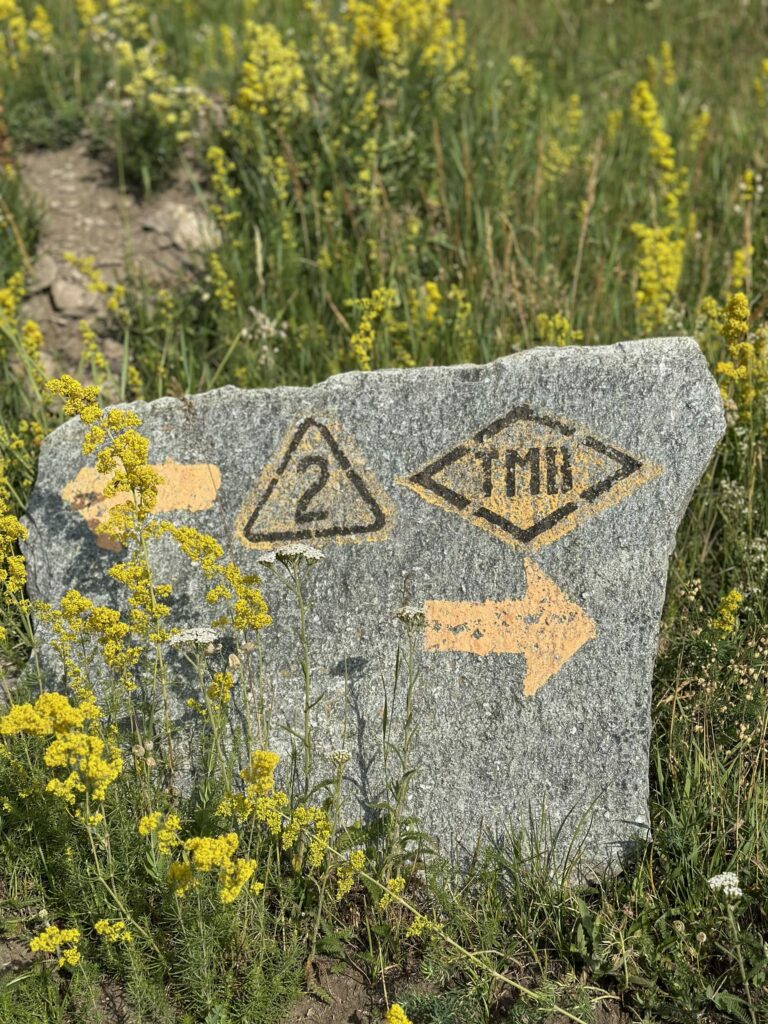
The first thing to know: the Tour du Mont Blanc hike is a GR, a Grande Randonnée long-distance trail, and it’s waymarked from start to finish. You’re not heading off into the void. In France, the waymarking is white and red: two parallel stripes mean “keep going straight”, they form an arrow to indicate a change of direction, and if they cross in an X, you’re not on the right path, so turn back. In Italy, the waymarking switches to yellow. In Switzerland, easy paths are marked in yellow, and the more committing sections (those that need a bit more attention) in white-red-white. Once you have these three codes in mind, you don’t get lost.
Physically, you don’t need to be an athlete, but you do need to be a regular hiker, comfortable with several hours of walking in a row and with ascent that builds up day after day. Cyril has run the UTMB, so on the motivation side he had nothing to worry about, but his dad, who is a “normal” hiker, had no problem keeping up the pace over 8 days. It’s clearly not reserved for top-level athletes.
Who it might not be the right plan for, however: if you set off completely alone and you’ve never done a multi-day trek, or if the idea of handling the unexpected (the weather turning, a full refuge, an ankle that twinges) stresses you more than it excites you. In that case, an accompanied option may make sense, and I come back to it below.
Guidebook, map or app: how to find your way alone on the TMB?
It’s THE question we get asked most after “how many days”. Here is what we used, concretely.
The paper guidebook. We had the official FFRandonnée topoguide, GR TMB (reference 028), in the pack. It costs 18.40 € and has 128 pages, with extracts of IGN maps at 1:25,000, the description of each stage, information on the refuges and points of interest along the way. It’s the kind of object that reassures: even without network or battery, you have the route and the context to hand. We leafed through it every evening to anticipate the next day’s stage.
Our GPX tracks. On top of the guidebook, we had redone our own GPX tracks before leaving, stage by stage, cross-checking them with our real breakdown (the one that doesn’t exactly follow the classic guidebook stages, since we were walking clockwise). It’s a real plus compared with following the waymarking alone: you see your position in real time, even in fog or at an unclear trail junction.
If you want to see our route on a map and get our GPX file, I made a map of the Tour du Mont Blanc with all our stages.
The apps. If you don’t want to bother creating your own tracks, apps are more than enough. The Cartes IGN app, free and official, lets you import a GPX track and download maps for offline use before you leave, which is essential since the network disappears quickly at altitude. Komoot is another solid option, with an offline map system by region (between 4 and 30 € to buy, or an annual subscription at 60 € if you hike a lot). In France, 62% of hikers now use a GPS app to follow their route, according to a 2024 FFRandonnée study. It’s no longer a niche practice, it has become the standard reflex.
Our method, if you want to copy it: the guidebook for context and evening reading, a GPX track downloaded offline for real-time navigation out on the trail, and the physical waymarking as a constant complement. With all three together, you can hardly go wrong.
Building your own itinerary, step by step
Organising a Tour du Mont Blanc without a guide comes down to four steps, in this precise order.
1. Choose your duration. It’s the first decision, and it conditions everything else. I detail each format, from the 3-day trail runner version to the contemplative 10 days, in my article on how many days to plan for the Tour du Mont Blanc.
2. Book your refuges, right after. Bookings for the summer open in mid-October of the previous year on the centralised platform, and the best beds go within a few days. It’s often that which dictates your final breakdown rather than the other way round. All the detail, refuge by refuge, is in my article on the Tour du Mont Blanc refuges.
3. Choose your direction and your starting point. Anticlockwise from Les Houches is the most classic and the best documented in guidebooks. We set off clockwise from Chamonix, which also worked very well, but it requires a bit more personal cross-checking between the guidebook (designed for the other direction) and your own track.
4. Prepare your pack with your navigation kit. Guidebook, downloaded GPX track, a power bank (essential if you’re counting on your phone for navigation), and a clear idea of your exit points in case a stage goes wrong.
Tour du Mont Blanc in 7 days without a guide: what to plan for
If you’re aiming for the 7-day format (the most in demand, which I detail in the article on duration), here is what changes on the independent organisation side. The stages follow one another with no downtime, which leaves little margin if a refuge turns out to be full at the last minute: book even earlier than for a longer format. For navigation, since the pace is sustained, it’s better to have your GPX track ready rather than relying only on the guidebook while walking, as you don’t necessarily have time to stop and decipher a map at every junction. The 7-day route follows the most classic and best waymarked stages of the trail, so it’s also the easiest format for getting hold of ready-made tracks if you don’t want to create your own.
Tour du Mont Blanc in 10 days without a guide: what to plan for
On a 10-day format, you have more room to improvise a little, which makes it a good choice for a first fully independent multi-day trek. The shorter stages leave time to check your position without stress, to stop in the villages, and to adapt if you have to change your route along the way (a full refuge, deteriorating weather). Be careful all the same: a long format doesn’t mean easy booking, the refuges go just as fast as elsewhere, you simply have more nights to fit in. It’s also the format that uses the most variants and secondary paths compared with the classic route, so the combination of guidebook and personal GPX track makes even more sense here than on a short, ultra-waymarked format.
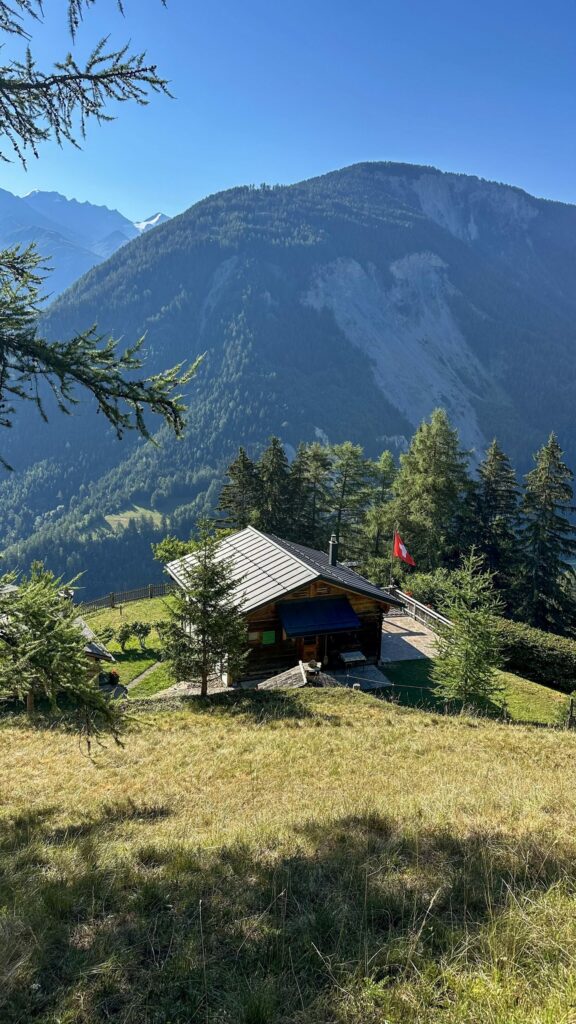
How much does the Tour du Mont Blanc cost without a guide? (full budget)
Here’s the real question behind “without a guide”: does it really work out cheaper? Yes, and by a long way. Here is a realistic budget for a 7-night, fully independent package, in refuges, mostly in France:
| Item | Budget |
|---|---|
| Accommodation (7 nights, half board) | 380 to 480 € |
| Lunches and drinks outside half board | 100 to 210 € |
| Return transport to Chamonix | Varies depending on your starting city |
| Navigation equipment (guidebook, map, app) | 20 to 60 € (one-off purchase, reusable) |
| Total accommodation + food | about 750 to 1,200 € all in, excluding transport and hiking gear |
This range matches well what we spent ourselves over 8 days. The complete detail of prices by refuge is in my dedicated article.
Without a guide, with a guide, or “self-guided”: the three options and their prices
Be careful, there is a common confusion about the term “without a guide”. Many agencies actually sell a “self-guided” package: they book your refuges and give you a roadbook and a GPX track, but you walk alone, with nobody beside you. It isn’t the same thing as full independence like ours, where you choose and book literally everything yourself.
Here are the three options, with real prices found at several specialist agencies and guides in the area:
| Option | What it includes | Indicative budget (7 days) |
|---|---|---|
| Fully independent (us) | You organise everything: route, bookings, navigation | 750 to 1,200 € |
| Self-guided via an agency | The agency books the refuges and provides a roadbook + GPX, you walk alone | 960 to 1,215 € |
| Accompanied by a guide | A qualified mountain leader walks with you for the whole trek | 1,010 to 1,475 € and more depending on the provider |
The advantages of full independence: it’s the cheapest, you’re totally free on your pace and your stops, and there’s real pride in having organised and succeeded on your own. The drawback: it takes preparation time beforehand (bookings in particular), and you’re the only decision-maker if something goes wrong.
The advantages of a self-guided package via an agency: you save an enormous amount of time on organisation (no more chasing bookings in October), often with luggage transport included, while keeping the freedom to walk at your own pace. The drawback: it costs more for a service that remains, at heart, logistics that you could do yourself with a little time.
The advantages of an accompanied guide: you benefit from field expertise, the safety of having a professional with you if there’s a problem, and the social side if you set off alone and want to meet people. The drawback: it’s the most expensive option, you lose freedom over the group’s pace, and the atmosphere depends a lot on the guide and the group you end up with.
Our choice, full independence, matched what we were looking for: the satisfaction of having managed everything ourselves, from the first step to the last. But none of the three options is a bad choice, it just depends on what you’re coming to this trek for.
Our tips for organising yourself well when you’re independent
Save the emergency numbers before you leave. 112 works in France and Italy. In Switzerland, the dedicated mountain rescue number is 144 (112 also works and redirects you, but it’s best to have the right reflex).
Always tell someone your itinerary for the day. Where you’re setting off, where you plan to arrive, roughly what time. It’s the simplest and most underrated reflex.
Cross-check several weather sources before each stage. In the mountains, the weather changes fast, and a single app can be wrong. We systematically checked two different sources the evening before setting off.
Keep a paper backup. A battery that gives out, a phone that falls into a torrent, it happens. The paper guidebook never needs recharging.
Don’t cut the switchbacks. Shortcuts on the bends speed up soil erosion, and it’s also often there that hikers get lost when they leave the waymarking.
Check the level of each stage before you set off, not while walking. It’s beforehand, with the guidebook or your track, that you identify the more committing sections or the passages that call for poles.
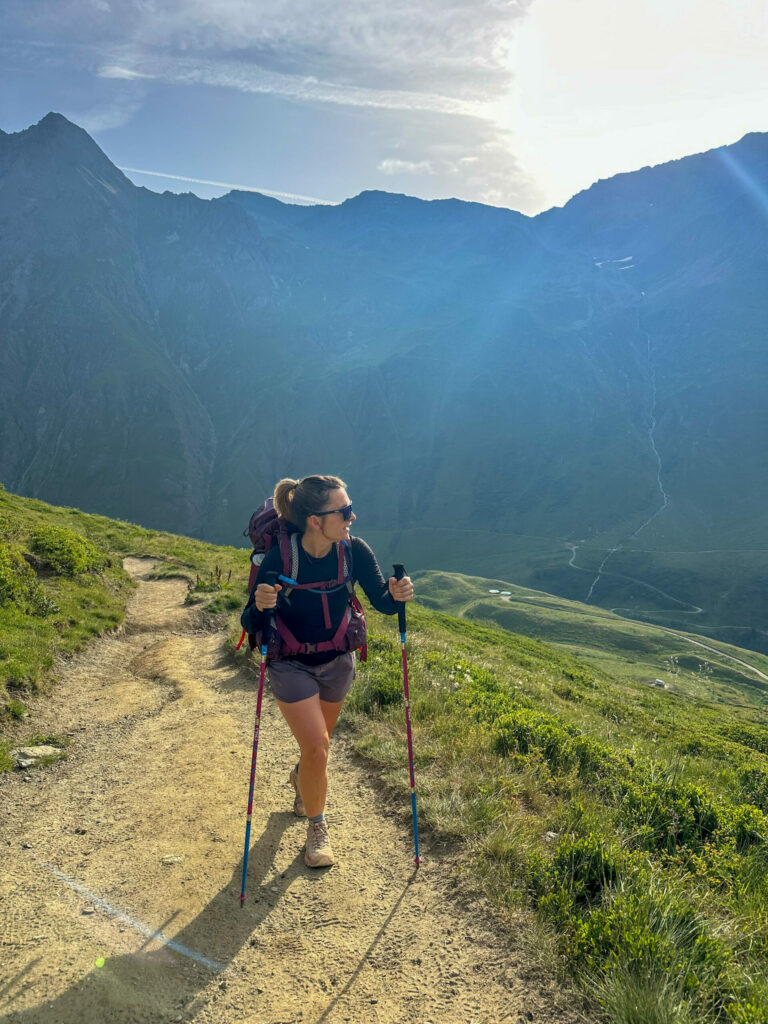
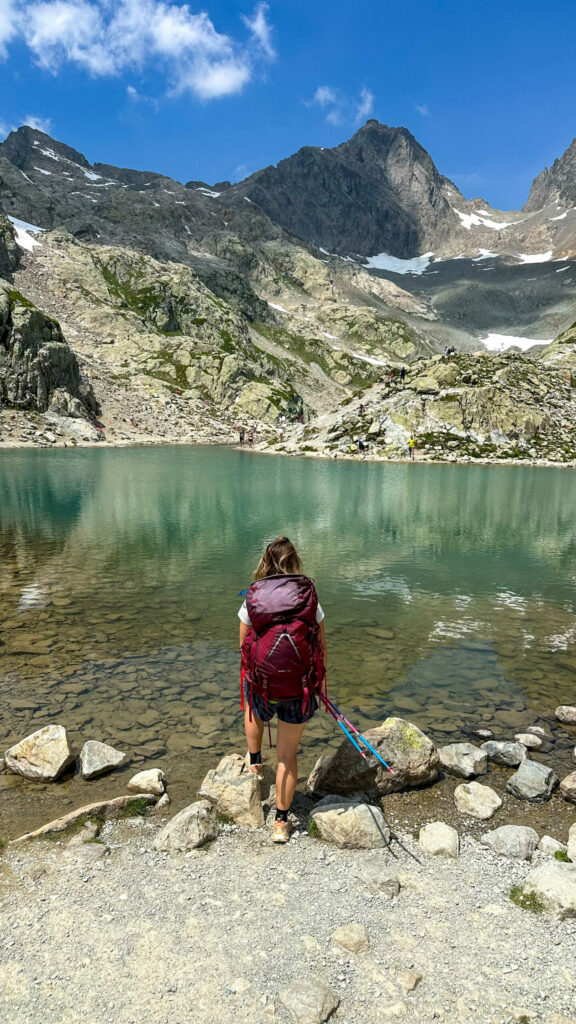
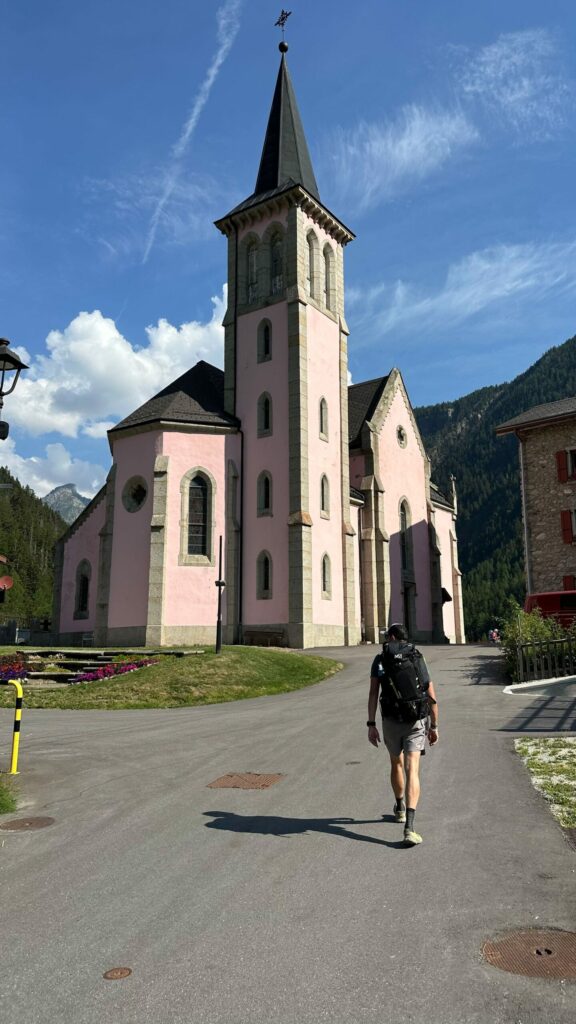
In short
Do you need a paper guidebook to do the Tour du Mont Blanc without a guide? It isn’t compulsory if you’re comfortable with a GPS app and a downloaded track, but it’s a real plus as a complement: it works without a battery and gives context on each stage that apps don’t always provide.
Is the Tour du Mont Blanc well waymarked? Yes, very well. The waymarking changes colour depending on the country (white-red in France, yellow in Italy, yellow or white-red-white in Switzerland depending on the difficulty of the section), but it’s consistent and reliable along the whole route.
How much does the Tour du Mont Blanc cost without a guide? For a 7-night, fully independent package, accommodation and food included, count between 750 and 1,200 €, excluding transport to get there and hiking gear.
Do you need a particular level to do it alone, without a guide? You need to be a regular hiker who is comfortable with several hours of walking and daily ascent, but not an athlete. The real criterion is your ability to cope with the unexpected (weather, fatigue, a full refuge) more than your pure sporting level.
How do you handle emergencies when you’re without a guide? 112 works in France and Italy, and in Switzerland the mountain rescue number is 144 (112 also works there). Always tell someone your itinerary for the day, and keep a paper map or guidebook as a complement to your phone in case the battery gives out.
There you go, you have all the keys to set off independently. The Tour du Mont Blanc without a guide is neither a feat reserved for an elite, nor a risky improvisation if you prepare things in order: duration, bookings, navigation. If you have questions about your own project, come and tell me in the comments or on Instagram, it always makes me happy to help someone get started.