I hesitated before writing this article for you. The Beaufortain was a real favourite of mine, and I almost wanted to keep it to myself. Of course, it is not an unknown destination either. On the contrary, it is more and more sought after, but sometimes you want to keep your little crushes jealously to yourself. Guilty of keeping a secret garden, let’s say!
In the end, after all the questions I received, I am going for it… but where do I start to explain why the Beaufortain is worth the detour? The landscapes you walk through all day are beautiful and varied. Even so, I would say the area charmed me above all with its unspoilt nature and its simplicity. The people, the architecture and the spirit in general are not showy, unlike some posh mountain resorts and villages. You simply feel good there.
It is the kind of place where you put down your bag, look around and tell yourself you could stay several days without ever getting bored. You could walk, run, watch the landscape change with the light, and eat one cheese after another without guilt. Many of you asked me for a complete guide to the Beaufortain massif. Some wanted to prepare a hike, discover the Tour du Beaufortain or choose where to walk with the family. Others wanted to understand the atmosphere of the Ultra Tour du Beaufortain. So I have gathered all the useful information here, with my own feedback.


Enjoying the Beaufortain: a quick word on responsibility
I am going to make a small aside. I will now do it in all my articles on hiking, the mountains and so on! It is great to want to enjoy nature. The more outdoor lovers there are, the more protecting it has to be at the heart of the discussion. BUT it is shameful to see how many people cannot keep their rubbish with them. Some cannot even go to the toilet outdoors without scattering shreds of paper for everyone to see. They damage the fauna and flora and do not know how to respect this environment. I find it completely unbelievable and very sad to walk in the middle of nature and soil it with your rubbish… anyway, this kind of behaviour is beyond me.
So loving nature, yes. Taking photos or selfies in front of beautiful landscapes, why not. But as soon as you are in a natural environment, you have a duty to be careful and to respect it. (It works in town too, of course.) This also applies to respecting marked paths and trails. Going off the trail can be dangerous for yourself and above all for the terrain (risk of erosion and so on). The message is clear… or so I hope. It is our duty to all be careful and to educate those around us.
Also read my article on the subject, “Can you swim in mountain lakes?“, for more information.
The Beaufortain: the area, the massif and the villages
Now that this little parenthesis is closed, I can sing the praises of the Beaufortain. For the record, we had pretty dreadful weather… with a few clear spells between the curtains of rain, luckily, so we could enjoy the beautiful scenery. Despite this very capricious weather, our stay in Beaufort left me under the spell of this region. I am convinced it would delight any nature lover. Come this way and let me tell you a bit more.
Where is the Beaufortain?
I can already see you discreetly searching Google Maps to find out where on earth it is. It is true that it is not the best-known region, so don’t worry! The Beaufortain, or “pays de Beaufort”, is in the Savoie department. This is in the French Alps, in the Auvergne-Rhône-Alpes region. Skiers will sometimes know some of the region’s essential resorts, like Les Contamines or Les Saisies. They may also know the famous Pierra Menta. It is an international competition of ski mountaineering on the legendary peak of the same name. Cheese lovers also sometimes know Beaufort without necessarily linking it to the village it takes its name from.
When you look at a map, the Beaufortain massif does not necessarily jump out at you. It is tucked somewhere between Mont Blanc (the highest peak in the Alps), the Tarentaise valley and the Aravis range, a bit in its own corner. Almost discreet, it is also far less famous than the latter. And yet, how beautiful it is! No need for long explanations. You arrive, you look up, and I dare you not to fall in love with it too. There are mountain pastures, gentle ridges, dam lakes, charming villages, and the feeling that life here still follows its own rhythm.
It is a massif that does not try to show off. It still offers a great variety of atmospheres and terrain, accessible to almost everyone. You quickly find your bearings, and I think that is what I liked from the very first day.

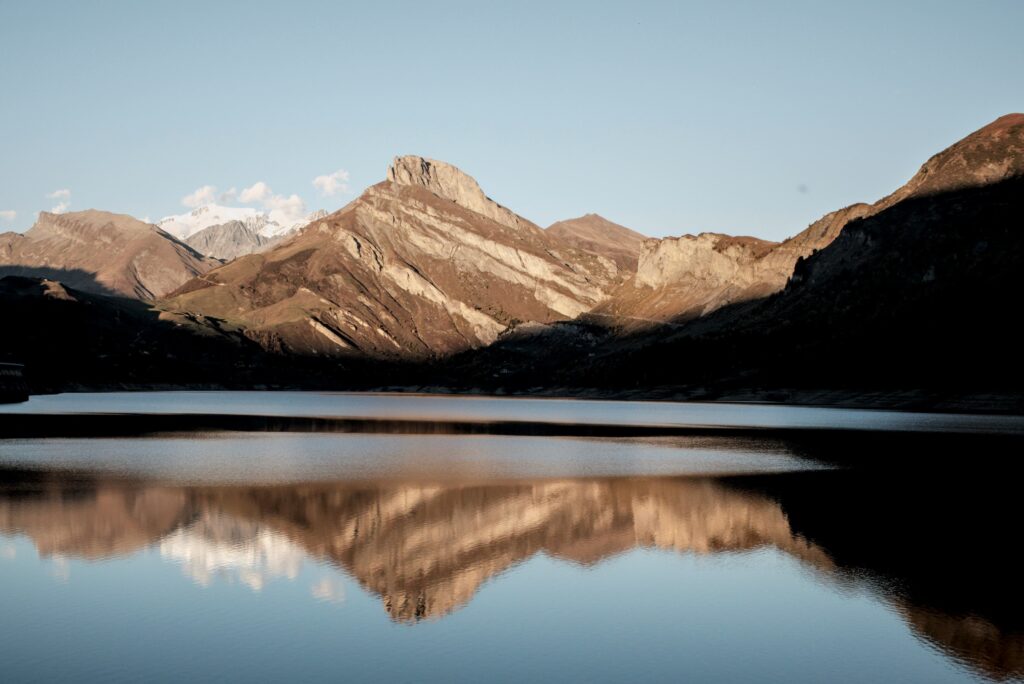
The Beaufortain massif
The Beaufortain massif is a massif of the French Alps, straddling the Savoie and Haute-Savoie departments. Its highest point reaches about 2,995 m with the Roignais summit.
The geography mixes Alpine relief, valleys, mountain pastures, forests and ridges. It also includes dam lakes (such as Roselend, Saint-Guérin and Gittaz), torrents and rivers.
It is a compact massif: relatively accessible, with frequent contrasts between valley and altitude. You go straight from a hamlet to a summit, from a lake to a mountain pasture. For hikers and trail runners, it is a really nice and varied area. You do not need to be an expert to find suitable routes. There are also demanding routes for the curious, for fans of elevation gain or for multi-day trips (what French hikers call itinérance).
These landscapes, these variations and this closeness between altitude and valley make the charm of the Beaufortain massif: variety, accessibility and geographical coherence.


The “pays de Beaufort”: the inhabited territory
Around this massif lies what is called the “pays de Beaufort”. It includes the valley, the villages, the alpages (high mountain pastures), the hamlets, the farms, the dairy cooperative, the network of roads and paths, and the daily life of its inhabitants. This human dimension brings the Beaufortain to life. It is not only a mountain backdrop but an inhabited territory that works, lives and breathes.
The pays de Beaufort is where the paths start and where you buy your cheese. It is also where the herds go up to the mountain pastures. This is where the balance between local life, farming traditions, tourism and nature is organised. It is what gives the Beaufortain the authenticity I appreciated so much. It is neither a bling resort nor a sanitised backdrop, but a corner where the mountain is part of a way of life.
Beaufort, Arêches, Les Saisies… the villages of the massif
To enjoy the Beaufortain, several villages serve as bases depending on what you are looking for:
- Beaufort: in the centre of the massif, it is the historic and strategic village. The Doron river runs through the valley and the roads converge, so it is a real crossroads. It is practical for radiating out and reaching the valleys or the trails. That also makes it a good compromise between comfort and closeness to the mountains when you look for somewhere to stay.
- Arêches-Beaufort: more mountain, more authentic, more “old-style mountain village”. It is a good starting point to explore the central areas of the massif, around the lakes or the mountain pastures.
- Hauteluce: a slightly different village, with gentleness, panoramas, old hamlets and a strong rural spirit.
- Les Saisies / Espace Diamant: Les Saisies is above all very well known as a winter resort. In summer it is also a gateway for hikes and trail running. It is a more structured resort, but still in the spirit of “simple mountains”.
Depending on the time of year and what you want (calm, hiking, comfort, easy access), you choose your village. Each has what you need to settle in, eat, sleep, and set off walking or running the next day.
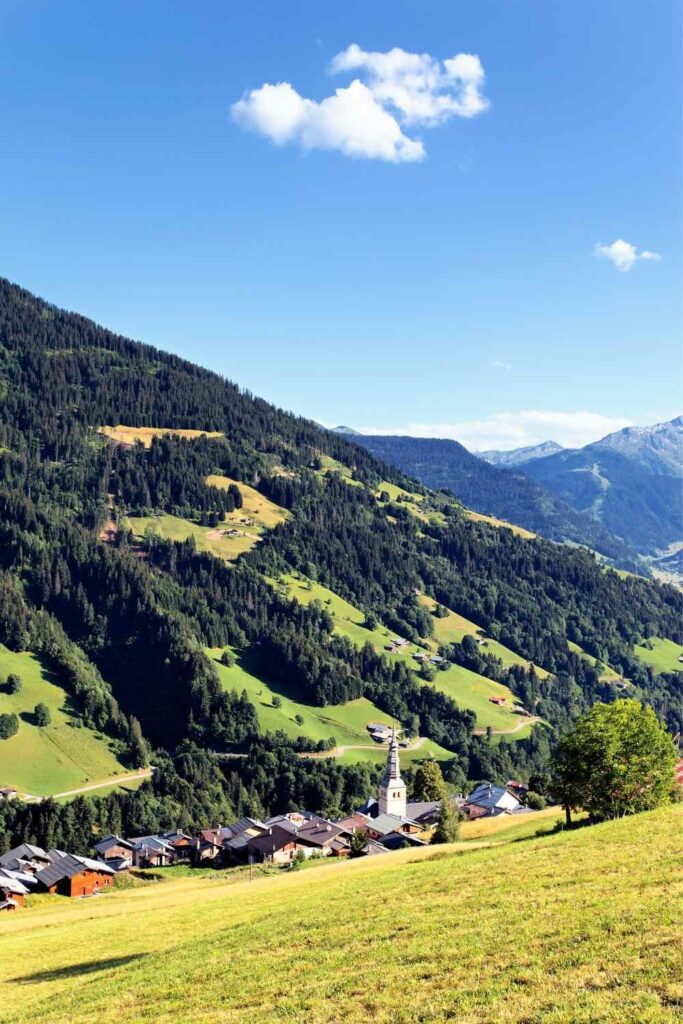

How to get to the Beaufortain
Let’s start at the beginning… how to get there! The good news is that it is fairly easy to reach the Beaufortain, as the massif is a few kilometres from Albertville station.
By car, allow about 2 hours from Lyon, 1 hour from Chambéry and 6 hours from Paris. The exact time depends on where you are staying in the Beaufort area. By train, you need to stop at Albertville station on the SNCF, the French national rail network. Be careful though: outside the holiday periods there are not many buses. You will need to book a taxi in advance or really plan around the timetable. In short, Albertville is your gateway to the Beaufortain, by car or by train.
Coach links between Albertville station and the Beaufortain resorts in the summer and winter seasons. Check the timetables and book on Altibus.com.
Worth noting: my mum and I chose to come by train. Unfortunately, on site, the summer bus shuttles between the villages of the Beaufortain had ended at the beginning of September. They start at the end of June. We took a bus once. The rest of the time we got around by hitchhiking, and it worked quite well! As a little bonus, it let us make some very nice encounters and change our plans for our last hike.
Where to stay?
We stayed in Beaufort, a few steps from the cheese dairy (pure coincidence, of course). I really liked the village of Hauteluce and that of Arêches-Beaufort, but if I went back, I would ideally choose to stay in Beaufort. I found it really charming and pleasant, and generally well placed to get around the Beaufortain.
However, at other times of year, in winter for example, being right in a resort can be a plus. In that case, look around Hauteluce, Les Saisies or Arêches to be closer. In any case, there are many places to stay, in hotels, guesthouses or Airbnbs. Options include Arêches-Beaufort, Beaufort, Bourg-Saint-Maurice, Crest-Voland, Granier, Hauteluce, La Côte-d’Aime, La Plagne Tarentaise, Les Contamines-Montjoie, Les Saisies, Naves, Queige and Villard-sur-Doron. In short, I would pick Beaufort for a summer stay. For winter, a resort village such as Hauteluce, Les Saisies or Arêches is better.
For more information, do not hesitate to look here!
What to do in the Beaufortain
Discover the lakes of the Beaufortain
The Beaufortain is known for its many dam lakes. The most famous of them is the Roselend dam. It sits between the col du Pré (which overlooks the little town of Arêches) and the Cormet de Roselend, a high mountain pass. It is reputed to be the most “aesthetic” of the Savoie dams. For the record, its construction led to the flooding of the mountain village of Roselend. It also led to the birth of the Beaufort dairy cooperative, thanks to the compensation paid by EDF, the French electricity company! 940,000 m3 of concrete were used to build the structure, so it is quite a beast.
The Cormet de Roselend is also very popular with cyclists, as the Tour de France, the famous cycle race, often passes there… this year, in fact, and next year too! With a view this incredible, why would they miss out!
There are many other dam lakes. One is the Saint-Guérin dam (1961), where we went several times. Another is the Gittaz dam, which did not leave me with an unforgettable memory, but then again it was cold. There is also the Girotte dam!
The Saint-Guérin dam
From the official website (in French): the walking route is accessible to all, including people with reduced mobility with a companion. It runs along the lake on the right bank to a Himalayan footbridge with an 83 m span and more than 20 m high. The footbridge lets you cross the Poncellamont Gorge.
Saint Guérin, patron saint of herds, gave his name to the valley and to the dam, built between 1957 and 1961. It helps fill Roselend. Its water surface is 50 ha and its depth 70 m, for a capacity of 13 million m3.
The Gittaz dam
The Gittaz dam, built between 1962 and 1967, can store 13 million m3 of water. Its “arch-gravity” structure with a triangular base uses its own weight to resist the force of the water.
Surface of the water body 39.3 ha, depth 65 m, length 164 m. The dam receives the Gittaz torrent and the water collected by the Sallestet intakes. That water goes directly through a 2 km gallery into Roselend lake.
Treat yourself at the Beaufort dairy cooperative!
The Beaufortain is also known for its cheese: Beaufort. This cooked, hard cheese is made from raw whole milk. It is sold under 3 names: Beaufort, Beaufort d’été (summer Beaufort) and Beaufort chalet d’alpage (mountain chalet Beaufort). Since 1968 it has been recognised as AOC (Appellation d’Origine Contrôlée, a French quality label). Since 2009 it has also been a protected designation of origin (PDO). So a very precise set of rules has to be followed to be a “real” Beaufort.
Production must take place in a precise geographical area: the high-mountain part of the Savoie department, in the Beaufortain/Val d’Arly, Tarentaise and Maurienne valleys. Only 2 breeds of cow are allowed, the Tarentaise (or Tarine) and the Abondance. Production is limited to 5,000 kg of milk per cow per year, and the cheese needs a minimum ageing of 5 months, for example. More information here.
It was reportedly called the “Prince of Gruyères” by Jean Anthelme Brillat-Savarin, and downright amazing by yours truly!
Plenty of outdoor activities, in every season!
Why should you not miss a short (or long) getaway in the Beaufortain? In a few words, the region is perfect for people who love wide open spaces and lovely hikes. The nature here is also still fairly unspoilt.
Trail running, hiking, mountain biking, road cycling… the region offers many varied routes for every taste. They are also very well waymarked, so it is fairly easy to find your way. Winter of course brings its share of adventures, with different options available, but I will tell you about that one day… if I am lucky enough to go back!
In the meantime, the hikes to do around here are pretty incredible, and here is my top 5:
Saint-Guérin dam. A superb place that we mostly saw in the rain, but which turned out superb at the first ray of sunshine. We set off from Arêches-Beaufort, followed the road and then took a path towards the dam. You can reach the dam by car. It is the starting point of many hikes, such as the Lac des Fées. The Saint-Guérin dam is worth the detour, and it “touched” me much more than Roselend, which is more massive. A short easy walk, accessible to all, lets you go all the way round it. And there is even a small refreshment hut, open in summer.

Col du Pré (col means mountain pass). About 1,000 m of climbing over a little more than 6 kilometres. The unbeatable view of Mont Blanc has to be earned. This hike from Beaufort is not easy at all, but it is really worth it!

Two more hikes for your list
Roselend dam, starting from the Gittaz dam. The totally improvised hike of the trip. We had in fact set off to hitchhike towards the Roselend dam. On the way we met a charming couple of hikers. They were enjoying the sun finally coming back to go on a little hike in the Beaufortain. They sold us their route so well that we followed them, a bit blindly! In the end it was a superb hike, starting from the Gittaz dam to reach the Roselend dam. It let us admire many chamois (a kind of mountain antelope) and magical viewpoints (and a Mont Blanc almost uncovered). One to do!

Lac des Fées. A pretty hike starting from the Saint-Guérin dam. Fairly easy and accessible to all, it reaches a pretty high-altitude lake, very small and rather cute. You can also enjoy the sound of the waterfall all along the climb.

A real favourite for the Beaufortain and for the Hôtel du Grand Mont
In general, I avoid hotels. Vans, Airbnbs, guesthouses (chambres d’hôtes), couchsurfing, camping and so on… I often prefer other kinds of accommodation, as a hotel is for me a place of passage with no charm or emotion. That was without counting on the Hôtel du Grand Mont, which gave my mum and me a most warm welcome. I never thought I would one day feel “at home” in a hotel, and yet! Located in the heart of Beaufort, it is run by several generations of women. They offer us hearty cooking, tasty conversations and a most welcoming service. I strongly recommend it!
Thanks to my dear mum, who organised this stay to perfection… and see you soon for more detailed hikes!

I also wrote about the Lac Noir hike in the Beaufortain (that article is not available in English yet).