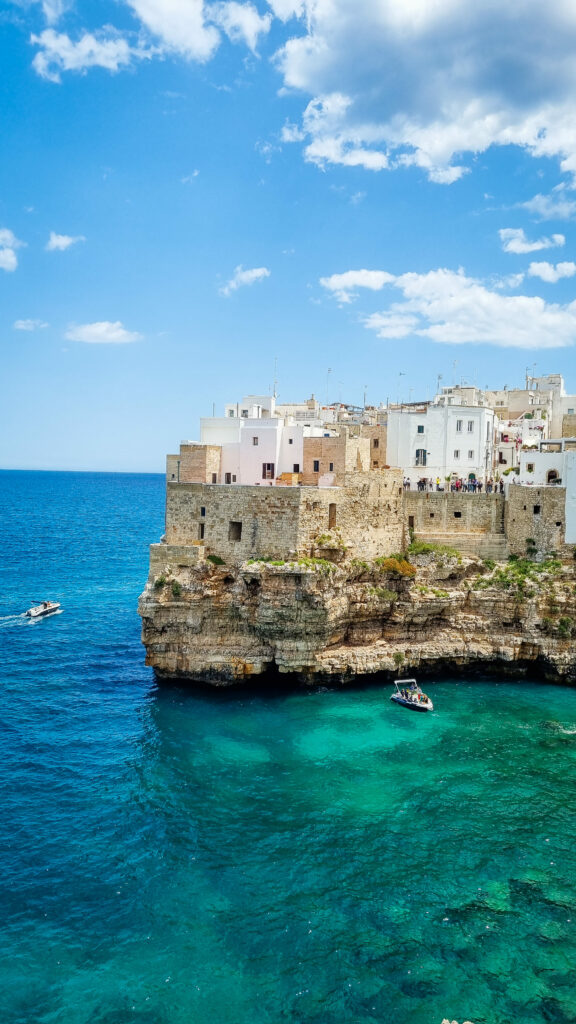
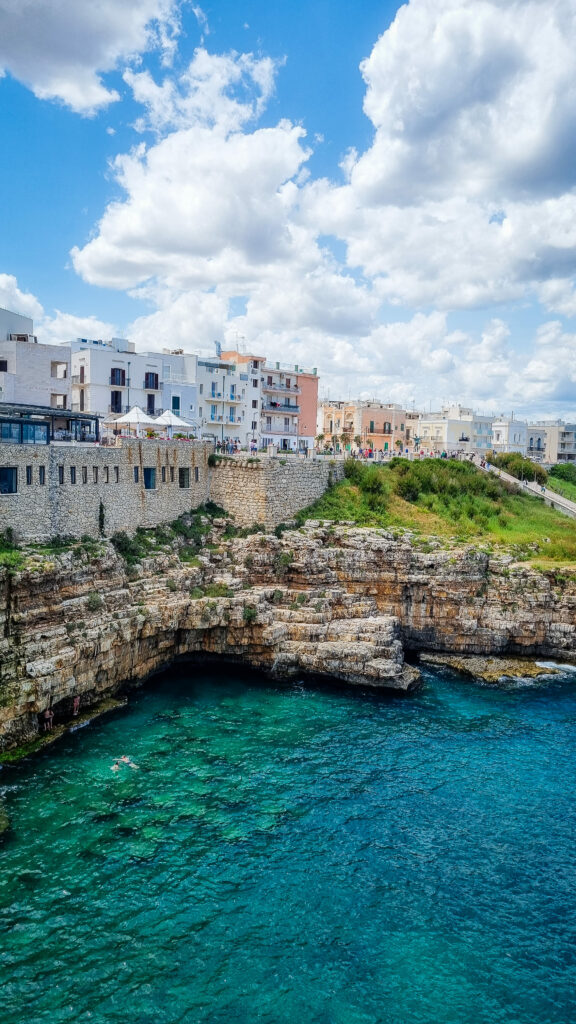
Our first stop on our one-week Puglia road trip was Polignano a Mare, a pretty town on the Adriatic. Polignano a Mare is often one of the first names that comes up when you plan a trip to Puglia. It is not only about the postcard photo of Lama Monachile (even if that is the picture you see everywhere). The town is small and easy to explore on foot. It brings together three things I really like in a seaside stop. There is a compact historic centre, impressive cliffs above the Adriatic and easy access from Bari (train, car or bus).
You can easily visit Polignano a Mare in a full day, or even half a day. Stroll through the lanes, take a break on the beach and stop at the viewpoints. Have an ice cream late in the afternoon, then watch the sunset over the cliffs. You do not need to organise much, but the town deserves more than a quick photo stop.
My guide gives you everything you need to visit Polignano a Mare with peace of mind. You will find the Polignano a Mare beach, the main sights and things to do in Polignano a Mare. I also cover practical details and where to park in high season. If you want to carry on to Alberobello or other nearby villages, you will find what to plan too.
Sommaire
Polignano a Mare, between history and cliffs
Polignano a Mare is a coastal town of around 17,000 inhabitants, between Bari and Monopoli on the Puglia coast. It differs from the other towns along the shore because it was built above the sea. It does not centre on a harbour or a wide beach. The whole old town rests on limestone cliffs hollowed out by erosion, with natural cavities opening onto the water. This geology gives the town its identity. It feels more vertical than seaside resort. (Puglia is the heel of Italy’s boot, if you picture the map.)
A town shaped by rock and erosion
The height of the cliffs varies around the centre. On average, you are between 20 and 25 metres above the sea. The sea caves (Grotta Palazzese, Grotta delle Rondinelle and others) are not just “pretty to look at”. They are karst formations: rock, usually limestone, that water has dissolved over time. They have served as access to the sea, as shelters, as storage areas and sometimes as fishing spots. Today you mostly explore them by boat or paddleboard, but they literally shape the coastline.
What struck me was not only the view from the cliffs. You can also hear the sea in the lanes. Even far from the viewpoint, you hear the waves rising through the cracks and cavities under the rock. It is quite unusual. You do not feel as if you are “facing the sea”. You feel as if you are standing above it.
A bit of history
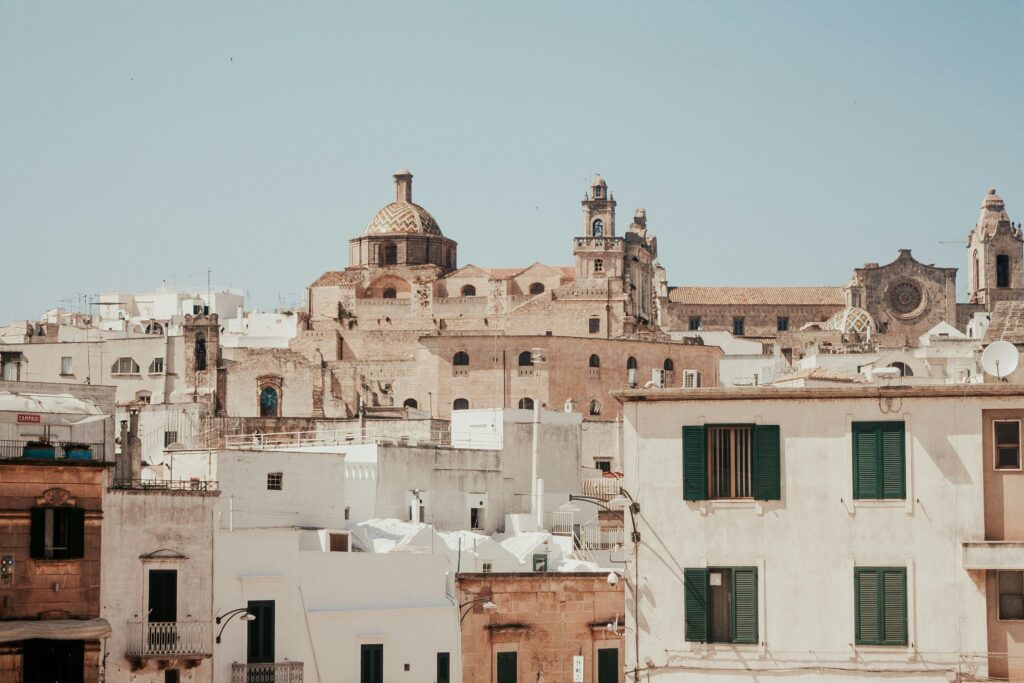
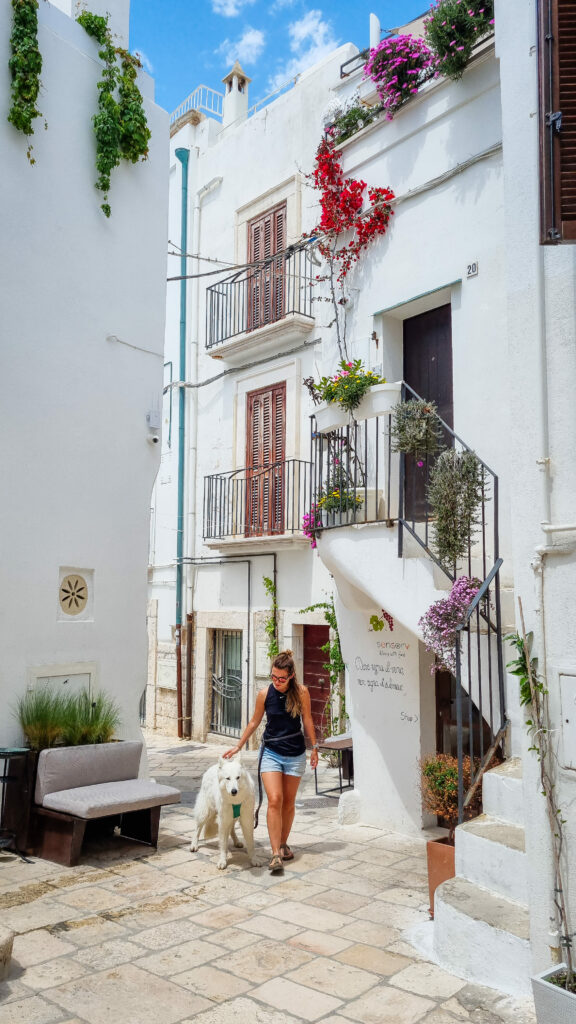
The site is said to have been inhabited from Greek times under the name Neapolis. It was then linked into the Roman network via the Via Traiana, a Roman road. But unlike other Italian towns, Polignano was not laid out around its ancient heritage. A few traces remain, but they are not the heart of the visit. The real interest lies in the whole picture. It is the topography, the white houses, the balconies over the sea and the little squares for a coffee. I find this is what makes the visit so pleasant: you do not “follow a route”, you explore. You go from a quiet lane to a headland. You walk back down to the beach, eat an ice cream, walk a little more… and the town unfolds naturally.
A practical stop in Puglia
Polignano a Mare is 35 minutes by train from Bari and less than 25 minutes from Monopoli. That makes it a logical stop on the coast before heading inland (Locorotondo, Alberobello, Martina Franca…). I came through on a single day. It is clearly the kind of town where staying a night pays off. You can enjoy the cliffs early in the morning, or the historic centre once the holidaymakers have gone home.
Polignano a Mare beach, or Lama Monachile beach
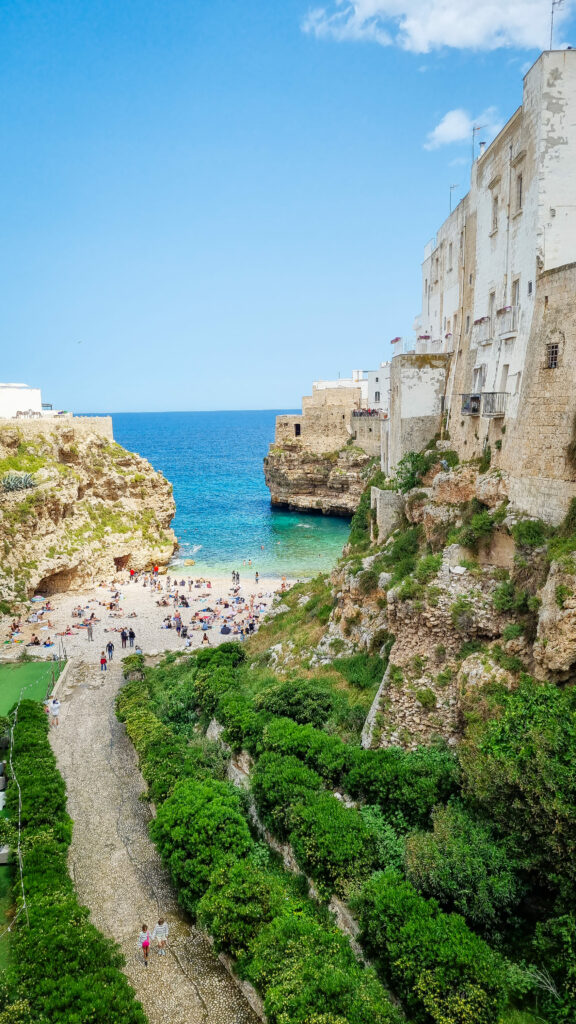
Wedged between steep tufa cliffs and the picturesque old town, Lama Monachile is the most iconic beach in Polignano a Mare. It is also called Cala Porto (cala is the Italian word for a small cove). This enclosed cove is squeezed between two rock walls. The houses of the old town overlook the scene from the top of the cliffs. This is the postcard landscape (and, let’s be honest, a hugely Instagrammable one) that you see everywhere.
Everything you need to know about Lama Monachile beach
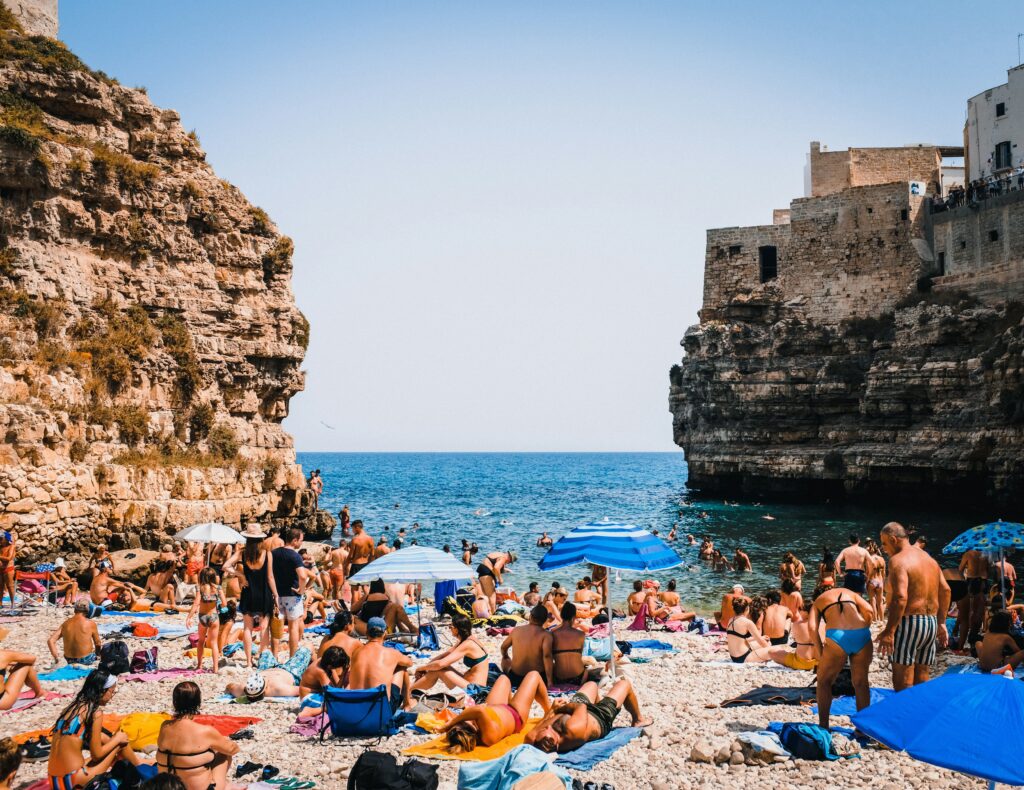
Lama Monachile beach is quite small: allow for roughly sixty metres in length, covered in smooth white pebbles. It is a long way from a big sandy beach where you set up your parasol for the day. Here everything is condensed: the sea, the rock, the people, the towels. It is this very vertical setting that makes it such a photogenic spot. The water is clear, truly transparent, with a rocky bottom in places. You can see why. As soon as you put on a mask, you spot fish and underwater reliefs.
At certain times of the day, the light changes quickly because of the height of the cliffs. You cannot necessarily see that in the photos. Part of the cove falls into shade while the top of the rocks stays in full sun. It makes for a special atmosphere, but it is good to know if you are coming to sunbathe.
Its seabed is full of life, which makes Lama Monachile a great spot for diving enthusiasts. Access to the beach is easy, with a walk of less than 500 metres from the main road. Several car parks are also available not far from the town and the beach.
Swimming at Lama Monachile: what to expect
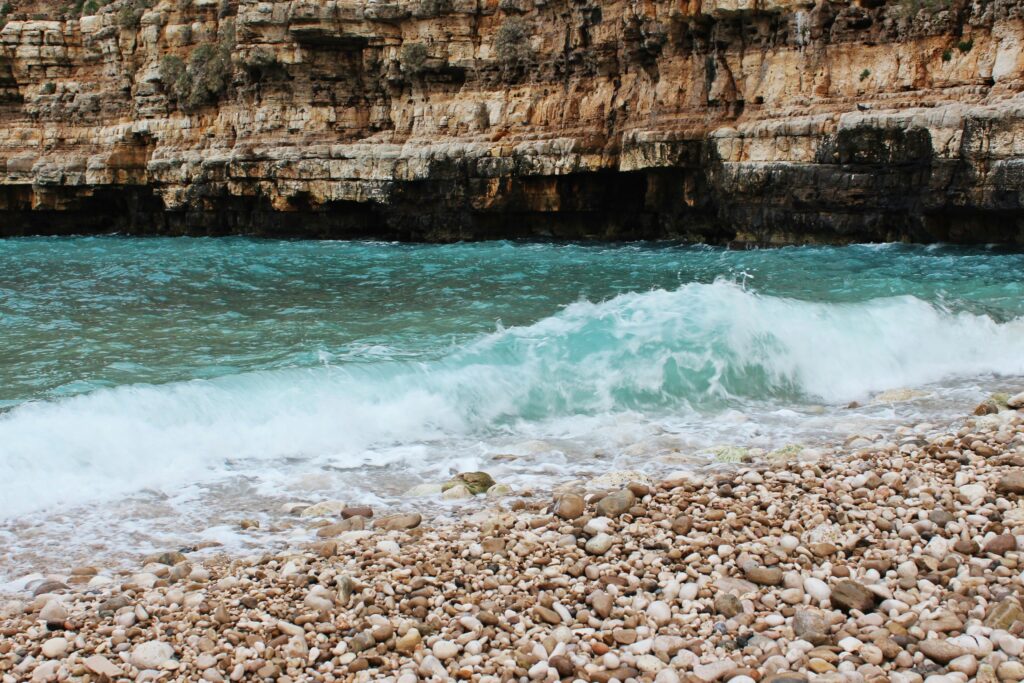
The beach at Polignano a Mare is mostly made up of pebbles. They are beautiful, but not necessarily pleasant on bare feet. If you have sensitive feet, water shoes make the experience much more comfortable. They help on the beach and when getting into the water. The entry is fairly gradual, but the bottom soon gets deeper than on a typical sandy beach. In practice, it is a good beach for putting your head underwater, swimming along the edges and snorkelling. If you plan to sit for a while, a folding mat or a padded towel makes the pebbles easier to live with.
In high season, Lama Monachile beach is very busy, sometimes even at the start and the end of the day. If you want some peace, the best slot is still early in the morning, before 9 or 9.30 am. Just before sunset also works for a quick dip and a softer atmosphere. In the middle of a summer afternoon, you have to share the cove with a lot of people.
Unsplash
Unsplash
Things to do in Polignano a Mare: the main sights
Polignano a Mare is easy to visit on foot. The old town is compact and the viewpoints are close to one another. You quickly go from the cliff edge to a lively lane. The best way to discover the town is to follow the coastline. Then slip into the lanes at random, alternating between sea views, walks and little breaks. Allow yourself time to wander rather than sticking to a fixed route. Getting a little lost is part of the pleasure here.
The best sea viewpoints in Polignano a Mare
The viewpoints are a real part of the experience here. You can follow the headlands all around the old town to see the coast from different angles:
Terrazza Santo Stefano: one of the best known, just above the Polignano a Mare beach. Pietra Piatta: a more side-on viewpoint, perfect at the end of the day. Ponte Borbonico viewpoint: the iconic view of the cove from the bridge. Balconies in the historic centre: small platforms looking straight onto the sea.
My advice: get up early and pick up a takeaway coffee. Walk down to the bridge to watch the town wake up. The cliffs are still in shade and the light filters between the lanes.
Piazza dell’Orologio
Piazza dell’Orologio (also called Piazza Vittorio Emanuele II) is one of the main squares of the historic centre. You are bound to pass through it as you explore the old town. It is a good landmark for sitting down, having a coffee or simply watching local life. The square is surrounded by light-coloured stone buildings, small shops and restaurants that are quite lively in the evening.
What catches the eye is the clock on the façade of the Palazzo dell’Orologio. Before it worked in the usual way, it was apparently driven by a manual system, according to some local sources. Residents of the neighbourhood looked after it. Even today it is an important symbol of the town, visible from the lanes that converge on the square.
Right next to it are a few buildings of interest, such as the archives and certain public rooms. Above all, though, it is a place of passage and everyday life. It is also a central point from which to branch out into the old town. You come back here almost automatically, whether you are heading to the viewpoints, the beach or the quieter lanes.
👉 If you want to stop for a drink, it is a good place for a break late in the afternoon. The old town gets livelier then. On the other hand, it is not the most authentic place to have dinner (it is rather touristy).
Credit: Unsplash
Credit: Unsplash
The Matrice church of Santa Maria Assunta
The Matrice church of Santa Maria Assunta stands on Piazza Vittorio Emanuele II, in the old town. It is a discreet but powerful witness to local religious history in Polignano a Mare. Consecrated in 1295, it was the town’s cathedral until 1818. Its “silhouette” is simple: a plain façade facing the square, and a bell tower standing next to it. Inside, the church has three naves and still holds important works. There is a 15th-century polyptych attributed to Bartolomeo Vivarini. There are also sculptures by Stefano da Putignano, active in the 16th and 17th centuries. The “Cappellone de San Vito” houses relics of the town’s patron saint.
If you visit Polignano a Mare, I recommend going in for a few minutes. The atmosphere is calm and the interior lighting is soft. It offers a pause from the bustle of the lanes and the sea views.
The contemporary art museum
As you stroll towards the seafront in Polignano a Mare, you will come across the Fondazione Museo Pino Pascali. It is set in the former municipal slaughterhouse, facing the Adriatic. It is worth a detour even if you are not a big fan of contemporary art. The museum brings together the work of Pino Pascali, an artist born in the region. He became a reference name in Italian art of the 1960s. It also hosts exhibitions by younger artists through the Pino Pascali Prize. What I liked was the contrast. You leave the old town and cross a calmer area by the sea. Then you step into an open, bright space with a view of the water. Pascali’s work often sets objects, shapes, natural elements and Mediterranean heritage in conversation. That suits the atmosphere of Polignano a Mare quite well.
👉 To be clear: I would not make it a priority if you are only staying two hours in town. But if you stay all day or like contemporary art, it is a good counterpoint to the cliff-top old town.
ThePonte Borbonico
The Ponte Borbonico (or Ponte Lama Monachile) is the bridge that crosses the gorge leading to Lama Monachile beach. If you arrive in Polignano a Mare by car or head towards the historic centre, you almost certainly cross it. It is also one of the best-known viewpoints over the cove. You see the sea on one side, the cliffs on the other, and the beach just below. The bridge dates mainly from the 19th century (around the 1830s). It was then used to link the coast road to the historic centre.
It is a place where you stop several times during your visit, not only on arrival. You can come in the morning to see the low light on the water. Then return at the end of the day, when the beach empties and the town lights up. It is not a “secret spot”. It is, however, a good landmark for understanding the geography of the town before you go down to the beach.
👉 If you want a “signature” photo of Polignano, climb up on the north side of the bridge. Look towards the town with Lama Monachile in the foreground. This is the framing you find in many guides.
See the statue of Domenico Modugno
The statue of Domenico Modugno, the singer of “Volare”, is one of the most photographed places in Polignano. It stands by the sea, a little below the centre, with a panoramic platform just behind it.
👉 A good option at sunset if you want a view of the town from the south.
Eat an ice cream or grab a snack in Polignano a Mare
In Polignano a Mare, you do not come only to “do the sights”. Your day is soon punctuated by gourmet breaks between two viewpoints or after a swim. You walk, you climb steps, you get lost in the lanes… You always end up stopping for an ice cream or something to nibble. It is a way of visiting in its own right here.
The best-known address is Mario Campanella, Il Super Mago del Gelo, on Piazza Giuseppe Garibaldi. It has been there for several generations. This is said to be where the caffè speciale was invented. That coffee comes with cream, lemon and a touch of amaretto. This is the kind of stop you make “to say you have been”. It is still nice to take a cone and move away from the square. Enjoy it with a view of the sea, rather than standing in the middle of the queue.
If you prefer a place that is a little less central, you can also try Caffetteria Primavera. They have ice cream but also hot panzerotti (small fried pockets of dough with a filling). That is handy if you want to eat quickly before heading off to explore the town. Nothing very formal, but perfect for a break between two swims.
Savoury snacks: panzerotti and focaccia
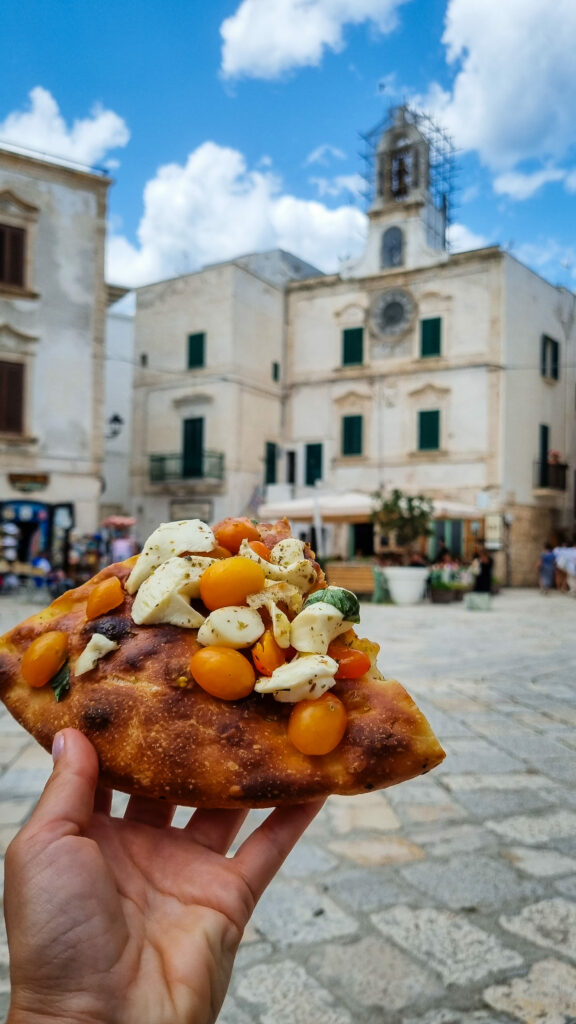
For something savoury, there are several small places near the bridge or Lama Monachile. You can pick up a panzerotto or a slice of focaccia to take away. For example, La Rotellina is often a good option when you want to sit facing the sea with something simple. If you would like more choice, Frumè Focacceria e Pinseria serves well-filled focaccias, arancini (rice balls) and other Italian snacks. The prices are reasonable.
One address I like for focaccia is La Focacceria delle Noci. The portions are generous, you choose at the counter and you leave with your bag still warm. It is the kind of meal you eat while walking, leaning on a railing with a view of the sea.
Take a boat or kayak trip to see the caves
Polignano a Mare is particularly known for its sea caves carved into the limestone cliffs. They are reachable only from the sea: Grotta Ardito, Grotta delle Rondinelle and the famous Grotta Palazzese. You can see them by boat (45 minutes to 1 hour 30). Kayaks and even paddleboards also work when the sea is calm. These trips let you follow the cliffs very closely and pass under natural arches. Sometimes you can enter the cavities directly, when conditions allow.
Most excursions leave from Cala Ponte Marina, a small harbour south of the historic centre. They follow the coast before heading back up towards Lama Monachile. The traditional boats stop briefly in front of several caves to explain how they formed. The longer tours usually include a moment to swim or put your head underwater. It is a good choice if you want a quick discovery without physical effort, especially with family.
Kayak or paddleboard around Polignano a Mare
For a more immersive experience, try kayaking or paddleboarding. It gives you a completely different relationship with the coast. You move more slowly and hear the waves against the rock more clearly. When the sea is calm, you can get close to the walls with precision. It is also the most interesting option for photos. The best time is in the morning, when the light enters the caves without being too harsh. In the middle of the afternoon, the number of boats can make the water cloudier and the experience less peaceful.
Trips are not guaranteed every day. They are often cancelled in an east wind, in a heavy swell or after a storm. The waves bounce off the cliffs and make entering the caves dangerous. From June to September, it is better to book in advance if you want a specific time slot. Out of season, it is often enough to simply turn up at the harbour.
What to bring on a boat or kayak trip
On the practical side, bring at least a waterproof bag (even on the “calm” boats). Add water shoes if you plan to swim from rocky areas, and a compact towel. The Grotta Palazzese you can see from the sea is the cave of the restaurant of the same name. You can look at it from the water. Access inside is only through the restaurant, and it is not a tourist visit.
Finally, if you are staying several days, some companies offer longer excursions towards Monopoli or San Vito. They include several swimming stops, which can be more interesting than the simple coastal tour around Polignano.
Visiting Polignano a Mare: how long should you allow?
I have seen a lot of people do Polignano a Mare “on the way back from Monopoli”. They take a photo from the bridge, go down to the beach for five minutes and leave again. Technically, you can do that. But it gives you no idea of what the town really is. You miss the sound of the sea under the cliffs and the lanes emptying in the evening. You miss the light on the caves at sunrise… in short, the atmosphere.
For me, the right length depends mostly on what you want to do with your day. Do you want to just see the town, or enjoy the sea as well? The next two sections break it down.
Visiting Polignano a Mare in half a day: doable, but very much a “quick look”
Half a day is enough to:
walk around the old town
take in two or three viewpoints
have a special coffee at the Super Mago del Gelo
go down to see Lama Monachile without settling in
That can work if:
you are staying in Bari and making several stops in the day
swimming is not on your plan
you just want to “see what it looks like”
But you will not enjoy the sea, the caves or the calm outside the busy hours. And in summer, this is often the slot when the town is at its most crowded.
Visiting Polignano a Mare in one day: the right format
A full day lets you alternate between:
a walk through the old town in the morning (before it gets hot)
the beach and a swim at Lama Monachile
a boat or kayak trip if the sea is calm
the lanes and an aperitivo late in the afternoon
a return to the cliffs for sunset
This format works well if you are doing a road trip in Puglia with 5 to 7 stops. You see the town at several moments of the day, in different light.
It is the format I recommend if you are going for the first time. You have time for the viewpoints, the beach and the caves without rushing.
Transport and access to Polignano a Mare
Polignano a Mare is very easy to reach. That is why many people make it their first stop when they arrive in Puglia. You can come by train, bus or car. It depends on whether you are leaving from Bari, from Monopoli or from further inland. Whichever you choose, check the timetables for the day you travel. Regional services can change from one season to the next.
Bari to Polignano a Mare: how to get there
Apart from the car, the simplest way to get from Bari to Polignano a Mare is still the train. The line runs along the Adriatic coast. It links Bari Centrale (the main railway station in Bari) to Polignano a Mare in about thirty minutes. Regional trains run frequently throughout the day. Tickets are cheap (a few euros). You get off directly at Polignano station, about ten minutes’ walk from the historic centre. It is the option I recommend if you are travelling without a car or staying in Bari. There is no parking stress and no ZTL (limited traffic zone) to deal with. You arrive already “in the right place”.
You can also do Bari to Polignano a Mare by bus. Regional companies (such as Ferrovie del Sud Est, or Flixbus at certain times of year) run the route. The journey takes about forty minutes. It is an alternative to the train. It is useful if the timetables suit your plans better or if you already have a bus pass. In practice, if you do not want to complicate things, the train or the bus both do the job well. That goes especially for a day trip. As with the train, it is worth checking the departure times locally before you set off.
Finally, you can of course drive from Bari by following the SS16 southwards. Allow around 30 to 40 minutes depending on traffic. It is handy if you are linking several stops in a day (Monopoli, Polignano, Alberobello and so on). You will need to think about parking when you arrive. If you drive on the left in the UK, take it slowly at roundabouts and junctions on your first day. In Italy you drive on the right.
Parking in Polignano a Mare
Once you are there, you do not really need a vehicle any more. The historic centre of Polignano a Mare is pedestrianised or very restricted, and everything is done on foot. Where it gets a little more complicated is parking, especially in summer. Park once, then explore on foot.
If you arrive by car, forget the idea of parking “at the foot of the beach”. The best approach is to aim for the parking areas around the centre and then walk 5 to 10 minutes. You have several options:
paid car parks close to the centre (such as San Francesco, Viale San Francesco d’Assisi, or Via Martiri della Resistenza). They are convenient, but quickly full in high season, and not cheap for a whole day;
streets with regulated parking (blue lines) a little further out. You need a ticket from the machine, but it is a good option for a few hours;
more “residential” areas on the station side (via Marconi, for example). You can sometimes find free or cheaper parking there, with a 10 to 15-minute walk to the centre.
At the height of the season, arriving early in the morning or later in the afternoon changes things for parking. It also makes the walk into town more pleasant.
If you are staying in town, some accommodation offers reserved parking or arrangements with a nearby car park. It can be worth checking before you book, especially if you are travelling with a van or a larger car.
Polignano a Mare to Alberobello: a possible day trip
Polignano a Mare can also serve as a base for an excursion inland. This works well if you want to see Alberobello without changing accommodation. To get from Polignano a Mare to Alberobello, you can use public transport or drive.
By public transport, there are again the regional buses (mainly Ferrovie del Sud Est). They link the station or the stops in Polignano to Alberobello in a little under an hour. Check the timetables in advance, because there is not a bus every ten minutes. But for a day it is doable. Leave in the morning, visit Alberobello on foot and come back at the end of the afternoon.
There are also train and bus connections via the local lines. Again, you need to plan this kind of route precisely, according to the day of your visit and the connections. If you do not like juggling timetables, the car remains the simplest solution.
By car, it is easy. You leave Polignano a Mare towards the inland and drive through the hills and olive groves. You reach Alberobello in about 45 to 50 minutes (around forty kilometres). It is what gives you the most freedom. You can stop in another village on the way (Conversano, Locorotondo, Martina Franca…) or come back by a different route.
To sum up: if you plan to visit Alberobello, combining it with Polignano a Mare works very well. Plan two days, or one well-organised day, especially if you have a car. By public transport it takes a little more planning. It is perfectly feasible if you look at the timetables the day before.
The best places to see near Polignano a Mare
With its rich historical heritage and dramatic coastal scenery, Polignano a Mare is an ideal starting point for exploring Puglia.
Start by visiting Bari, the lively capital of the region. Wander through the lanes of the old town and discover the majestic Basilica of Saint Nicholas. Enjoy the local food scene, known for its authentic street food, notably the famous focaccias. Bari also has a lovely promenade along the lungomare (the seafront). It offers a panoramic view of the Adriatic Sea.
Next, head to Monopoli, a fascinating seaside town with its charming harbour full of colourful fishing boats. Take the time to discover the local sights and do not miss a visit to its landmark cathedral.
Ostuni, nicknamed the “White City”, will delight you with its whitewashed houses shining under the southern Italian sun. Wander through its winding streets and enjoy the panoramic view of the sea from its high viewpoints.
Alberobello, a UNESCO World Heritage town, is famous for its trulli, dry-stone houses with conical roofs. It is a real journey back in time. You can immerse yourself in the culture and history of the region.