Sete Cidades is one of the places that comes up most often in lists of the most beautiful hikes in the Azores. It also appears in every list of top spots. Think photos of viewpoints above a blue lake and a green lake. Think roads running along the ridge, and views that really stop you in your tracks. In short, it is clearly on the list of things to see and do on the island of São Miguel.
I went there in October, during my trip to the Azores. The weather was perfect that day, and we were very lucky. This meant we could enjoy the place all day long. If you plan to go, check the weather at Sete Cidades just before you set off. Conditions change very quickly, especially at altitude.
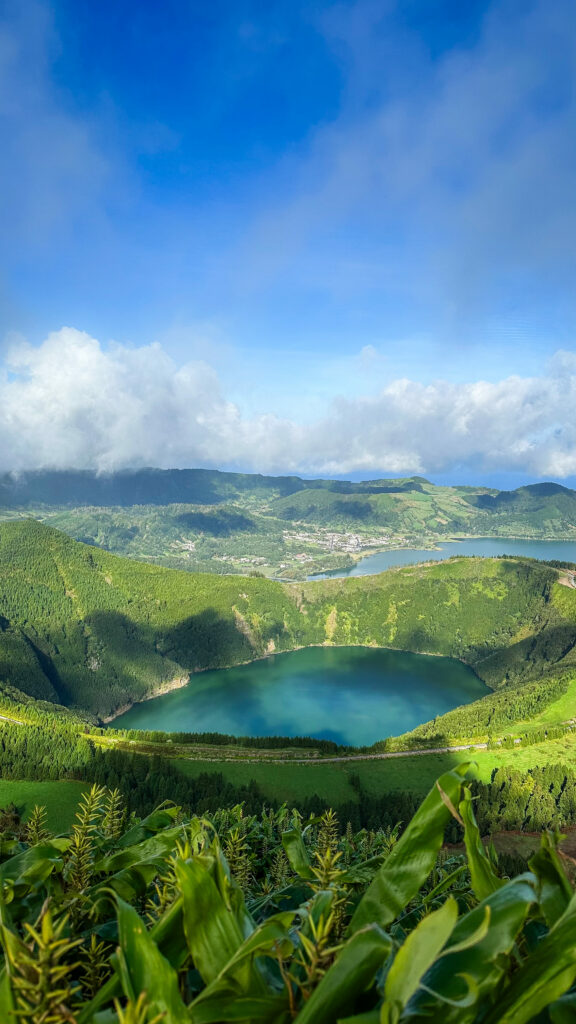
The landscape is stunning, with that contrast between Lagoa Verde and Lagoa Azul. You also get the sea in the distance and the Azores green everywhere. Discovering the caldera (the huge crater left by the collapsed volcano) on foot, rather than staying at the main spot, was really nice. I spent a good half day at Sete Cidades. It remains one of my most beautiful memories of the Azores.
So I am giving you all the information below, so you can enjoy it too.
Sommaire
All you need to know about Sete Cidades
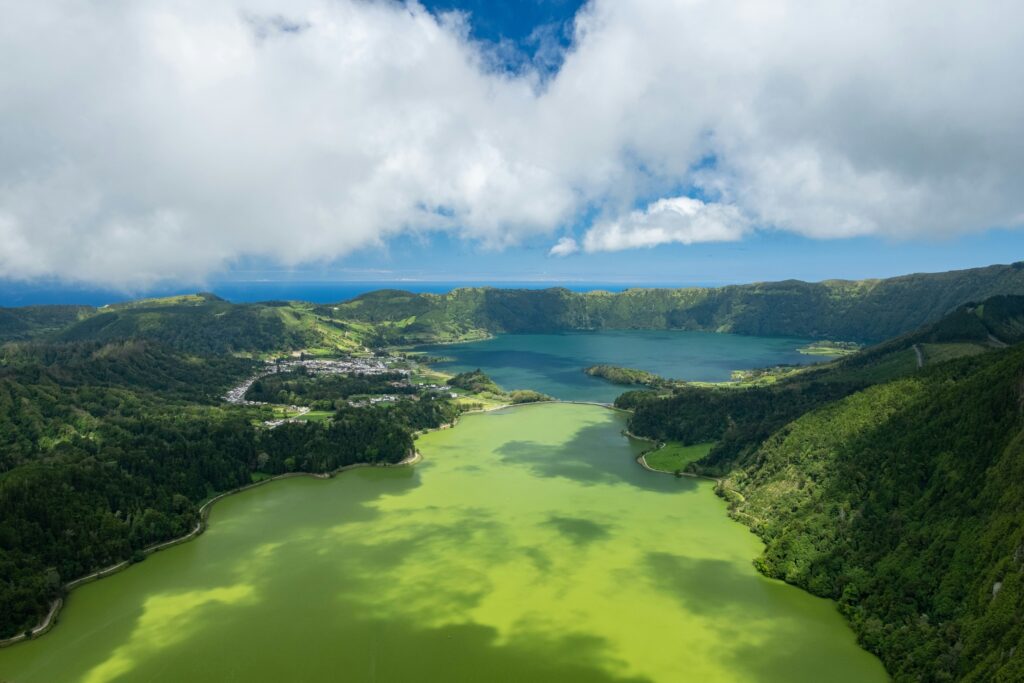
I vaguely knew that Sete Cidades was “two lakes in a crater”. I had not realised how huge the site is until I got there. It is an immense, almost geometric circle, with two lakes side by side at the centre and a village below… This is not a valley but a caldera. An old volcano collapsed, and the crater was then filled with water and vegetation. I loved this mix of imposing volcanic relief and a very gentle atmosphere once you are inside.
Sete Cidades is not just one viewpoint
What causes confusion with Sete Cidades is that it feels like a single spot, a viewpoint. In reality it is a whole: a geographical place, a village and a lake system. To keep it simple:
Sete Cidades is first of all the name of the caldera: a huge, circular, collapsed old volcano. It forms this whole area in the west of São Miguel.
At the bottom of this caldera there is a large lake, called Lagoa das Sete Cidades. The lake is made up of two parts:
- Lagoa Azul (the “blue lake”, the bigger part, on the north-west side)
- Lagoa Verde (the “green lake”, further south, slightly smaller)
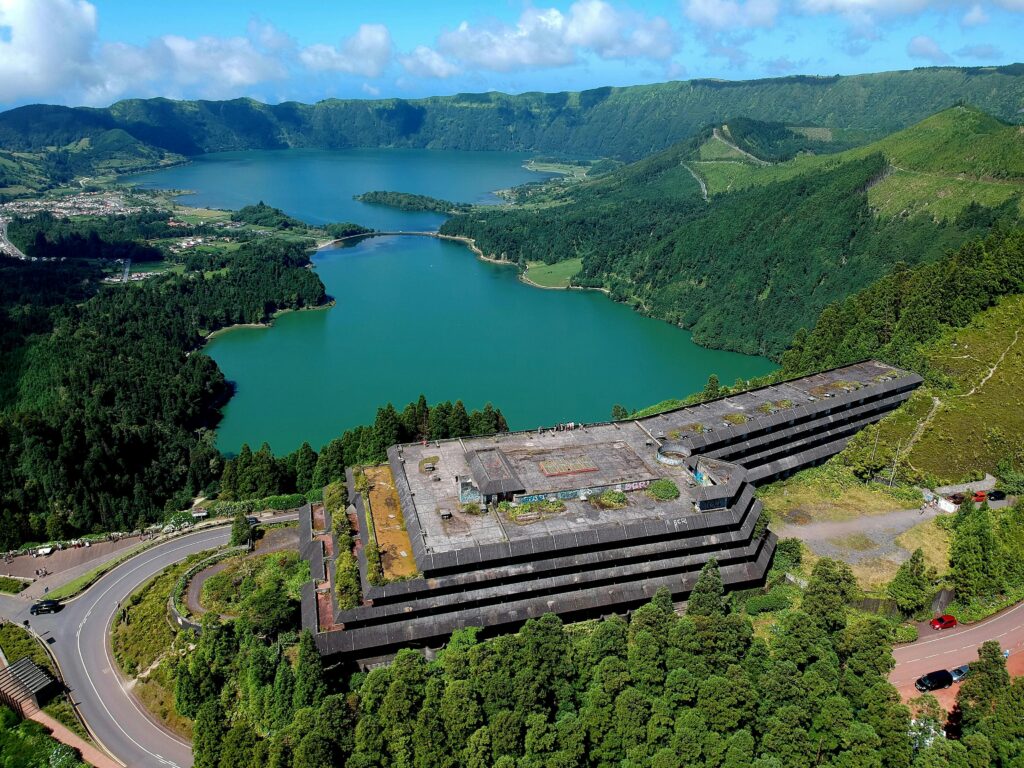
The two are not completely separate lakes, because they are linked by an isthmus with a bridge. That is why people sometimes talk about a single lake with two colours, and sometimes about two distinct lakes. It is not just a difference of name. You can really walk or drive from one to the other in a few minutes.
The village of Sete Cidades
Finally, there is the village of Sete Cidades, sitting on the edge of Lagoa Azul. It is a real village, not an artificial tourist site. There is a church, houses and fields, and it gives its name to the whole area. Many people think that “Sete Cidades” means the Vista do Rei viewpoint. That is what you see everywhere on Instagram. In reality, it is just one of the observation points overlooking the whole.
That is also why I think it is important not to stop at the viewpoints only. Go down to the village, on foot or by car. You go from a spectacular landscape to something simpler and more everyday. Then you understand what gives life to this place.
As for the atmosphere, I was also surprised by the village at the bottom. I expected something very touristy. In the end it is calm and almost rural. You find fields, simple houses and very few people away from the classic photo spots. It adds to this slightly “out of time” atmosphere.
Where Sete Cidades is and how to get there
Sete Cidades is in the west of São Miguel, not far from Ponta Delgada. By car it is very easy, and there are plenty of car parks at the points of interest. You can also take a bus down to the village, but there are not many buses. A mountain bike (preferably electric) is a good option if you want to do the full loop without a car. However, you need to like climbing. You also have to handle potential gusts on the ridges.
What I really recommend, if you can: drive up and make two quick stops at the viewpoints. Then switch to hiking mode to follow the curves of the crater, instead of simply collecting viewpoints. The loop is much more peaceful and less overrun than the various viewpoints. Above all, it lets you admire the surroundings of the lakes in a different way.
Lagoa Verde, Lagoa Azul… and what the photos do not show
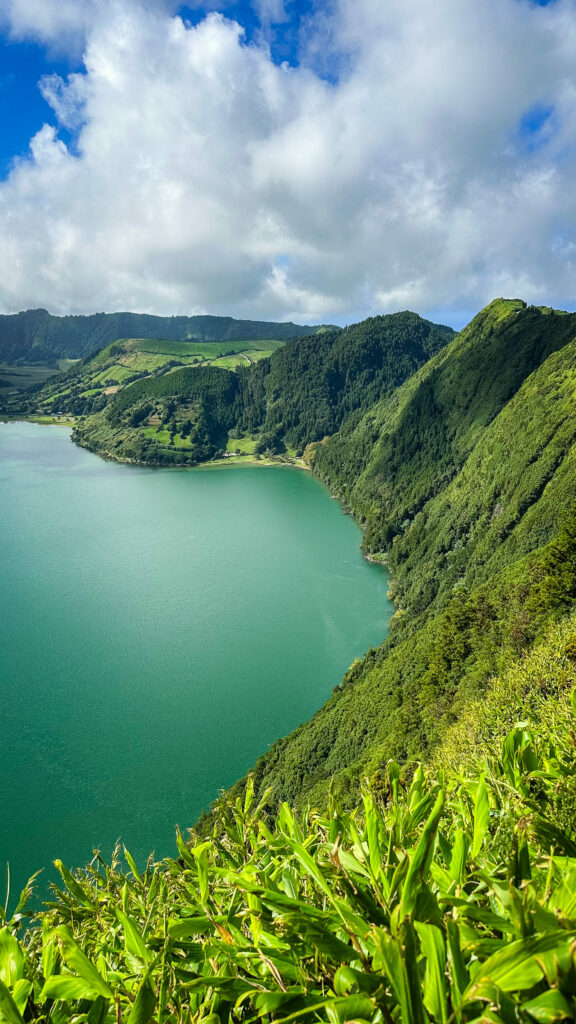
On Google, you get the impression of a fluorescent green lake and a bright blue lake, side by side. In reality, Lagoa das Sete Cidades is a single lake system, separated by a small bridge. The colours vary with the light, the depth and sometimes the vegetation. Nothing is uniform. And as the light changes, so do the colours, which is beautiful.
What also surprised me was the feeling of being in a huge place that is still lived in. You can be on the ridge with that spectacular view. An hour later, you can be walking between hedges and passing a tractor. You forget completely that you are at the bottom of a volcanic crater. That shift is what I liked. It is not just the most “Instagrammed” spot around. There really is a way to have a lovely hike and enjoy yourself.

The best viewpoints at Sete Cidades
At Sete Cidades, you can very quickly fall into the combo of “I drive up, I get out, I take a photo, I get back in, next”. It works, but it is not really how I like to discover a place (you know that). What I advise is to choose a few specific viewpoints and understand how to get there. Then stay a little and walk around from that viewpoint, and so on… Even if it means doing fewer, it is better to do them well.
Miradouro da Vista do Rei
From Ponta Delgada, it takes about half an hour by car to reach the Miradouro da Vista do Rei (a miradouro is simply a viewpoint in Portuguese). You follow the road west and take the direction of Sete Cidades. Then the road climbs in hairpins to the edge of the caldera. The viewpoint is signposted. There is a small car park right next to it, plus a few spaces along the road when everything is full. In season, it fills up fast!
Once parked, you walk barely a few dozen metres and find yourself facing the “postcard” version of Sete Cidades. The two lakes are right below, the village sits by the water, and the slopes of the crater close the circle all around. In clear weather, you can see the bluer side and the greener side well. Honestly, though, it depends enormously on the light and the clouds of the moment.
The atmosphere, on the other hand, is very much a “compulsory stop”: constant coming and going, cars turning, people staying five minutes exactly. It is useful for getting your bearings and seeing the whole, but I would not have stayed there an hour. If you can, try to go either quite early in the morning or later in the afternoon. The flow calms down then. You can at least enjoy the view without feeling like you are in a ski resort car park.
Miradouro da Boca do Inferno
At the Miradouro da Boca do Inferno, the atmosphere is completely different. You keep driving to the Lagoa do Canário / Mata do Canário area: a small forest road, roadside parking and quite a lot of space. Once parked, you cannot see anything of the caldera yet. You have to walk a little to get there. And it is so much nicer that way, discovering the caldera little by little and letting yourself be surprised!
Walking to the Boca do Inferno viewpoint
From the car park, you first follow an easy track. Then a narrower path climbs gradually towards the ridge. The distance is not huge: about 1.2 km to the viewpoint (so 2.4 km out and back), with around a hundred metres of elevation gain. The ground is sometimes muddy, and there are steps and a few steeper sections towards the end, but nothing technical! Simply, it is not suitable for pushchairs or for people with reduced mobility.
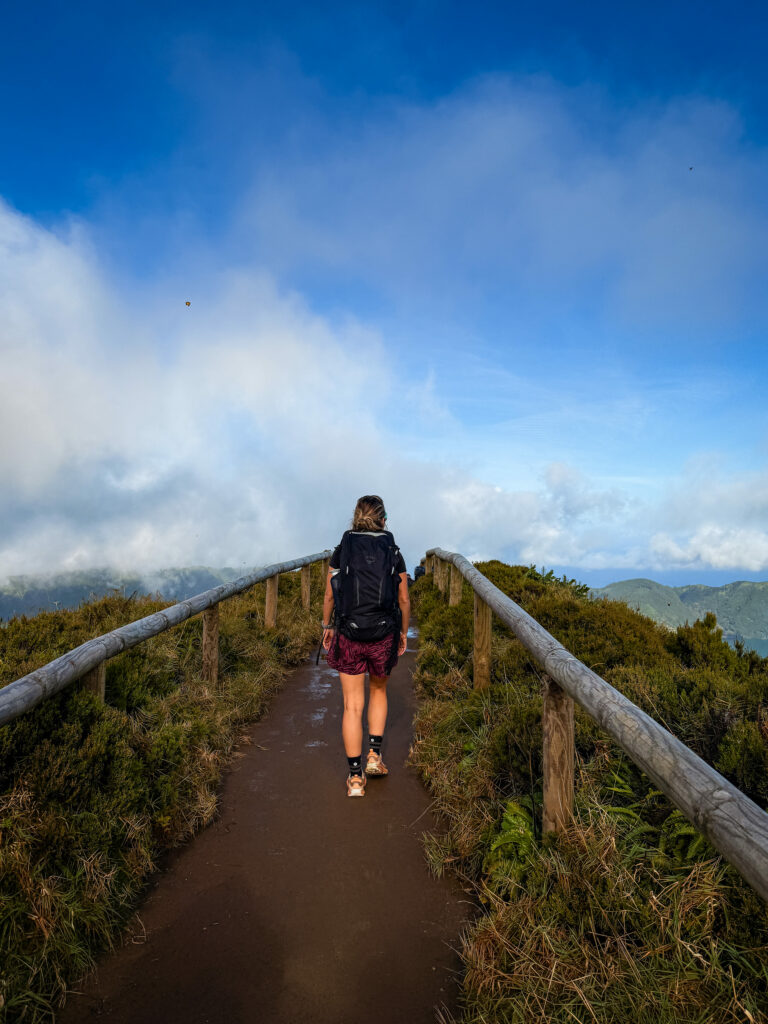

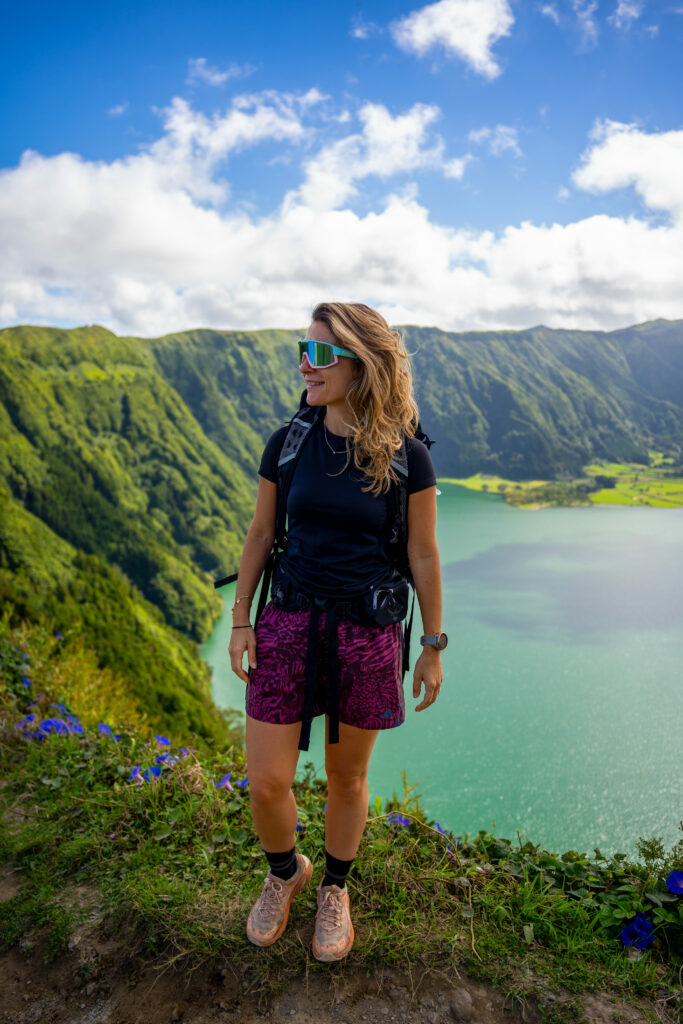
The arrival is really special. You step out onto a natural platform at the edge of the cliff, with a very wide view over the whole Sete Cidades caldera. You can admire the two lakes, but also all the relief around them and the other small lagoons. On really clear days, you can even see the Atlantic in the distance. This is where I felt the “old volcano” side the most: the slopes, the curves, the depth of the landscape.
As it has become a very sought-after spot, there can be a lot of people. Still, it feels more “earned” than Vista do Rei, because you have to walk a little to get there. That filters out some of the visitors. If you want to avoid the bulk of the groups and the buses that stop at the car park, the best slot remains the morning before 9 am or the end of the day. Keep an eye on the weather, because the viewpoint is often in the clouds.
Miradouro do Cerrado das Freiras
The Miradouro do Cerrado das Freiras is on the road linking the village of Sete Cidades to the ridge. Basically, if you drive down from Vista do Rei towards the village, you can go past it without realising. Pay attention to the signs. It is a small recess at the roadside, with simple parking, a railing and a flat space to step forward.
The view is different from the other two viewpoints. You are neither at the very top nor at the very bottom. Instead, you are a little “to the side”, with a lateral angle on Lagoa Verde and Lagoa Azul. You can see very clearly the strip of land that separates the two stretches of water. The road heading to the village and the relief of the volcanic massif behind are also visible. Buses do not stop there much, because the car park is too small. So you mostly find individual cars or people coming up from the village on foot or by bike. It is a very good stop if you do the loop around Sete Cidades. You can sit for ten minutes and watch the reflections change on the lakes. Then you carry on without feeling rushed.
Miradouro das Cumeeiras
This one is often forgotten because it is not right next to the best-known car parks. It is really worth the detour, though, if you want a more panoramic view that is less “postcard-oriented”. You get there by following the ridge road north of the caldera, towards the farming area overlooking Lagoa Azul. There is a small recess to park, but nothing as formal as Vista do Rei. If you follow the road slowly, you will recognise the place. The viewpoint opens up almost all at once, with a stone wall and an open space where you can walk a little along the ridge.
Why Cumeeiras feels different
What really changes here is the angle. You do not face the two lakes as in the “classic” photos. Instead, you observe them more from the ridge, slightly set back. You get the feeling of seeing the caldera as a whole, rather than a scene laid out in front of you. The relief stands out better, and you also see the shape of the crater in the background. That gives the view a more “geological” side, without being too raw.
It is also an interesting spot if you have already been up to Vista do Rei and Boca do Inferno but want something calmer. When I went by, there were a few cars and locals stopping to chat, with almost no selfie queue. We stayed a while watching the clouds rise from the sea, and the atmosphere was much more relaxed. It is the kind of place where you can take out a flask and walk a little along the ridge. It is also a perfect starting point for a stroll.
Just be careful with the access: the road is sometimes narrow, and if the weather closes in, visibility drops very quickly. If you want to explore the ridge on foot, it is also a good starting or finishing point for a longer loop. You can head notably towards Vista do Rei or Mata do Canário. It suits people who like walking!