If you’re prepping your TMB, you’ve probably already figured out that the real challenge isn’t your legs. It’s knowing where you’re going to sleep. This is a hut-to-hut trek from start to finish, and Tour du Mont Blanc refuges (or huts, if that’s the word you’re used to) get booked months in advance, sometimes sell out in a matter of hours, and more often than not, they’re the ones deciding your itinerary, not you. We did the loop in 8 days, clockwise from Chamonix, with Cyril and his father, and our 7 nights largely shaped our route. In this article I’ll give you our honest take on each refuge, the prices we paid, a map of where everything sits, and above all the method for booking without ending up sleeping on a bench in Courmayeur.
How do Tour du Mont Blanc refuges actually work?
First thing to understand: on the TMB, “refuge” (what English-speaking hikers often just call a hut) is a catch-all word. You’ll find guarded high-altitude refuges at 2,700 m with no shower, cozy alpine gîtes at 1,900 m, valley inns with double rooms, and even hotels that offer dorm beds. The comfort level varies enormously from one night to the next, and that’s just part of the deal.
The way it operates, though, is roughly the same everywhere. You book half-board: that includes the dorm bed, dinner, and breakfast. Dinner is usually hearty, often three courses, featuring local specialties. Breakfast is more basic: bread, jam, coffee. Drinks are never included, except for the jug of water. You can order a packed lunch for the next day, to be requested the evening before, budget 12 to 14 €.
A few rules that come up everywhere and are worth knowing in advance:
A sleeping bag liner is mandatory in almost all refuges. Some sell disposable ones on-site (3 € at Le Fioux, for example), but if you’re doing 7 nights in a row, bring your own: it’s cheaper and more comfortable. You leave your boots at the entrance and slip into the refuge’s crocs. One detail worth knowing: Bonatti no longer provides these, so bring lightweight slippers if you’re staying there.
Schedules are strict. At Refuge du Fioux, check-in is between 3pm and 6:30pm, dinner at 7pm, breakfast between 6:30 and 7am, and you need to have cleared out by 8:15am. That’s representative of what you’ll find elsewhere. This isn’t a hotel. You don’t show up at 9pm asking if there’s any food left.
One last point, and not a minor one: some refuges only take cash. Refuge de Bertone, for instance, is cash only. And there are no ATMs at altitude. The last ones are down in the valleys (Chamonix, Les Houches, Les Contamines, Courmayeur, Champex). Plan on 50 to 70 € in cash per night, in small bills.
How much does a night in a refuge cost on the TMB?
Might as well tell you straight away: the Tour du Mont Blanc is not a budget trek. It’s actually your biggest expense. Here are the real price ranges we found, by country:
| Country | Half-board in a dorm |
|---|---|
| France | 50 to 70 € |
| Italy | 50 to 80 € |
| Switzerland | 60 to 100 CHF |
Over a full loop, that adds up fast. For a 7-day itinerary (so 6 nights in refuges, with the last day bringing you back to your starting point), budget around 380 to 480 €. For a 10-day itinerary (9 nights), you’re easily looking at 550-600 €. And that’s without the packed lunches (10 to 14 € a day), without the well-earned beers on a terrace, and without the extras.
Because yes, there are extras. Some refuges charge for the shower. Others charge to recharge your phone. The local tourist tax is paid on-site, usually under a euro per night, but it adds up. And at Bertone, half-board includes a token for something, which gives you an idea of the level of detail you need to check before you go.
My advice: budget generously. Over 8 days, between the nights, the packed lunches, and a few well-deserved beers, plan on 600 to 800 € per person for lodging and food. That’s the price of not having to carry your own tent and food.
How to Book Tour du Mont Blanc Refuges: When and How It Works
This is THE touchy subject, and the one people get wrong most often. I’ll be very clear: if you start looking in May for a July departure, you’re out of luck. Or rather, you’ll have to cobble together a patchy itinerary around whatever’s left.
Here’s how Tour du Mont Blanc refuges booking actually works, whether you call them refuges or huts.
Most accommodations go through the centralized platform montourdumontblanc.com, run by the association of TMB refuge and gîte keepers. Availability for the following season generally opens at the end of September or beginning of October. For the 2026 season, it opened on October 15th, and there were actually quite a few bugs on the new site that forced bookings to close again for a while. The most in-demand places then sell out within days, sometimes within hours.
But not everything goes through this platform, and that’s where it gets complicated. Some independent refuges work by form or email: that’s the case for Rifugio Bonatti, Rifugio Elisabetta, and Refuge Bellachat. Others have their own online booking system, like Rifugio Elena or Refuge du Lac Blanc. And some, like Refuge des Prés or Refuge du Col de la Balme, now have their own website.
So in practice, you’ll be juggling three different channels to piece together your itinerary. It’s not very convenient, but that’s just how it is.
My recommendation: block off an evening in October, have your itinerary roughly mapped out already, and book everything in one go. Start with the most popular and the smallest refuges, since those are the ones that go first. Rifugio Elena is tiny relative to demand, Bonatti is legendary so it gets stormed, Croix du Bonhomme is a must on the classic route. If one link is missing, your whole schedule falls apart.
That’s exactly what happened to us, and it’s why we ended up doing 8 days instead of 7. Availability dictated our pace. I go into more detail on this in my article on how many days to plan for the Tour du Mont Blanc, because the two topics are completely linked: your number of days depends on your available beds, not just your legs.
Quick reminder if you were thinking of playing it loose with bivouacking: in some zones, campsites also need to be booked, and they fill up fast too.
Our 7 nights on the Tour du Mont Blanc: the honest rundown
We did the loop clockwise from Chamonix, which is why our stages don’t match the classic breakdown you see everywhere. Here’s each of our nights, with what I actually thought of them.
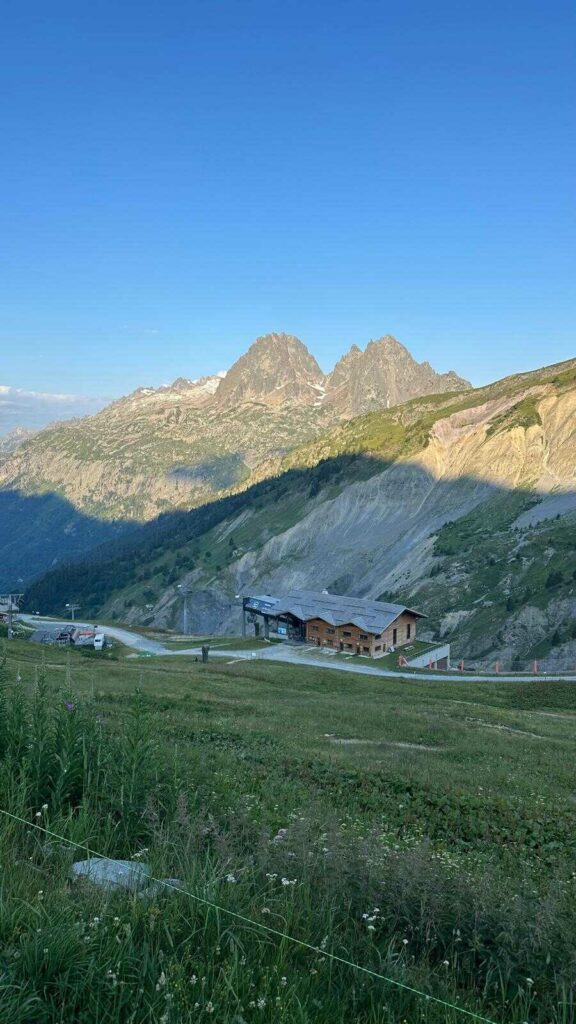
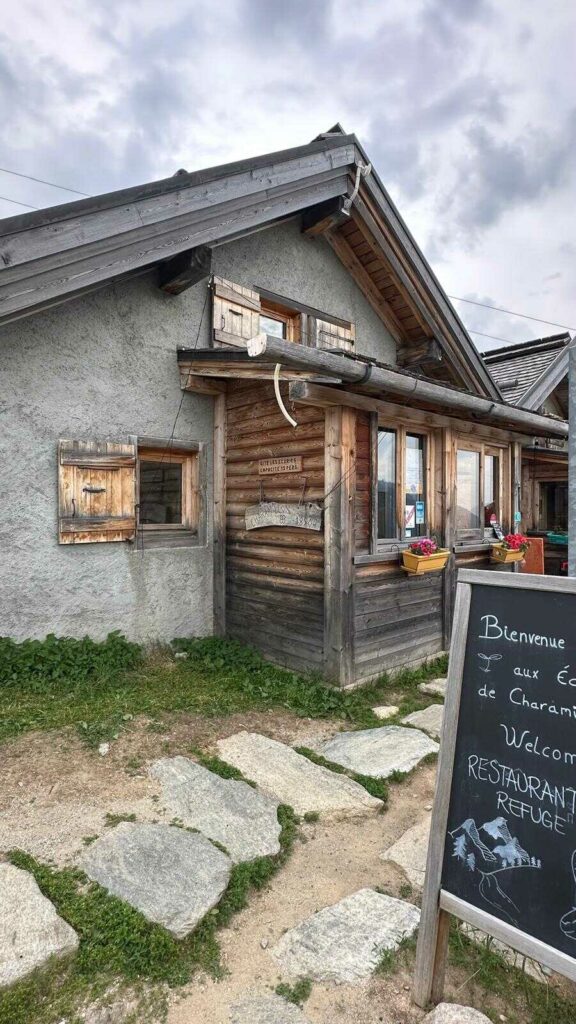
Gîte d’alpage Les Écuries de Charamillon (1,900 m, France)
Our Day 1, after 20 km and 2,000 m of elevation gain from Chamonix.
This used to be a barn where they made cheese from Hérens cows, those famous black cows. Five buildings once run by Jeanne, René’s wife, a well-known figure in the valley. The place has real character, and the sun-drenched terrace facing the Mont Blanc range was worth the climb on its own. The meal was very good, with an actual vegetarian option (yay).
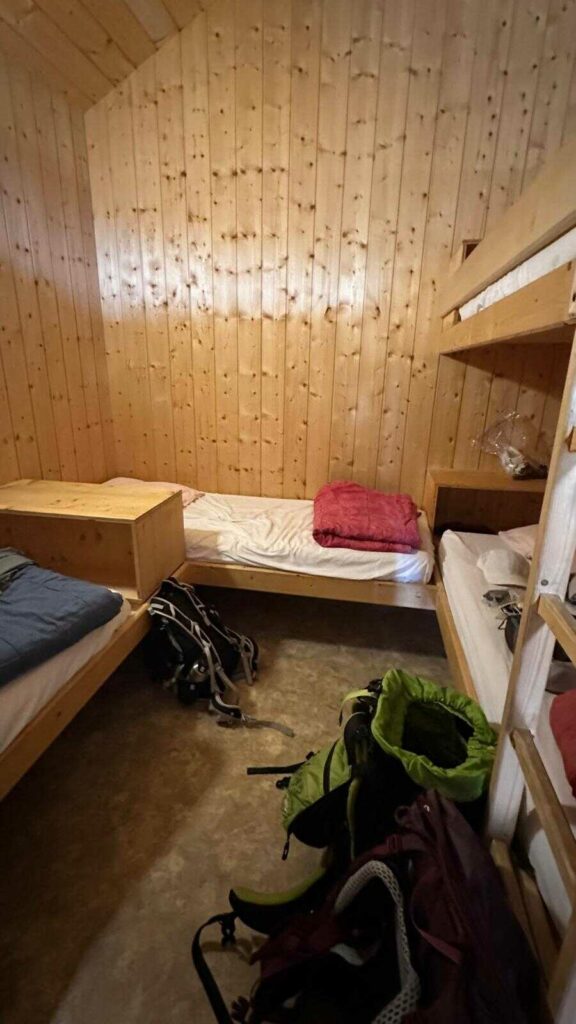
It’s small: 19 beds across 5 dorms, 3 showers, 2 toilets. Let’s just say you get to know your neighbors fast. Hot showers are free, there’s wifi and a drying room, which is no small thing. Sleeping bag liner required.
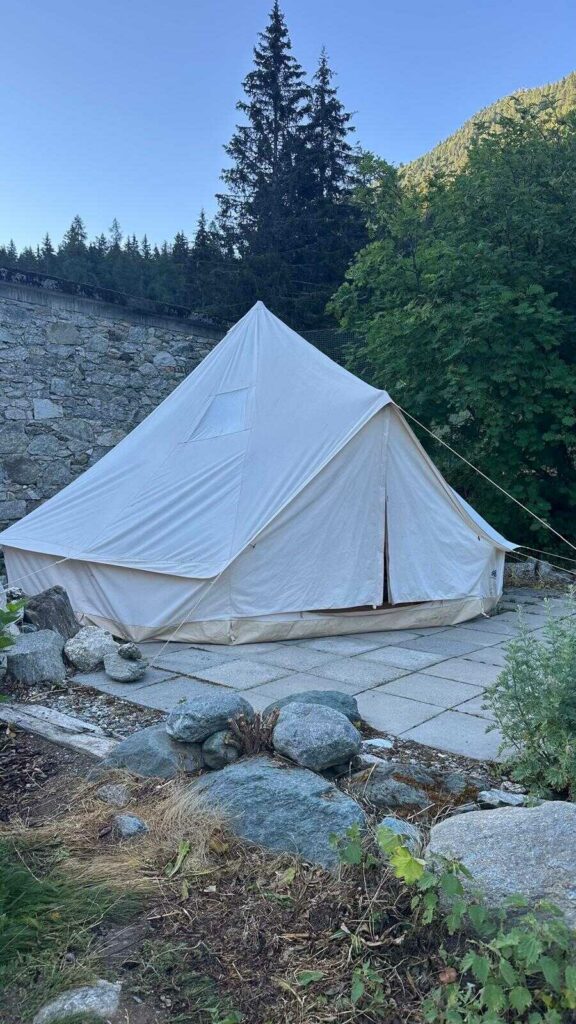
Price: 65 € for half-board in a dorm, plus 13 € for the packed lunch and 0.80 € tourist tax. There’s also an equipped tent option for 2 people at 120 €, and a bivouac spot for 10 € if you have your own gear.
My take: you can get there from the village of Le Tour in an hour’s walk, or in 15 minutes from the Charamillon cable car if you want to cheat. For a first night, it’s perfect: you’re already in that alpine-pasture mood, with marmots as neighbors.
Auberge Gîte Bon Abri (1,444 m, Champex-Lac, Switzerland)
Our Day 2, 21 km from Charamillon.
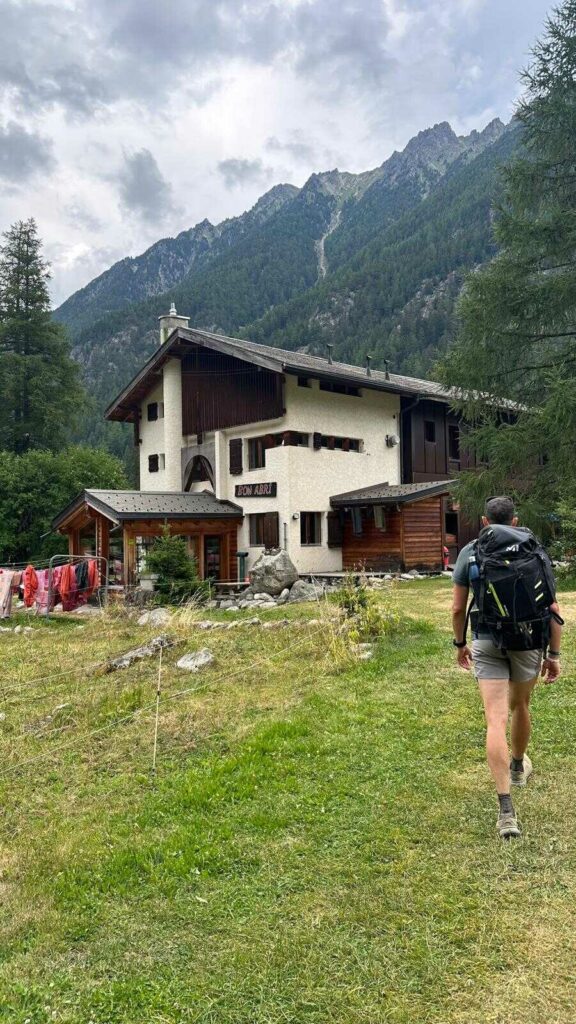
Heads up: contrary to what you might think, Bon Abri isn’t in Trient but in the Champex valley, 1.2 km from Champex-Lac. It’s a big gîte, up to 59 people in summer, with a large 18-bed dorm, rooms of 6, and a few double rooms.
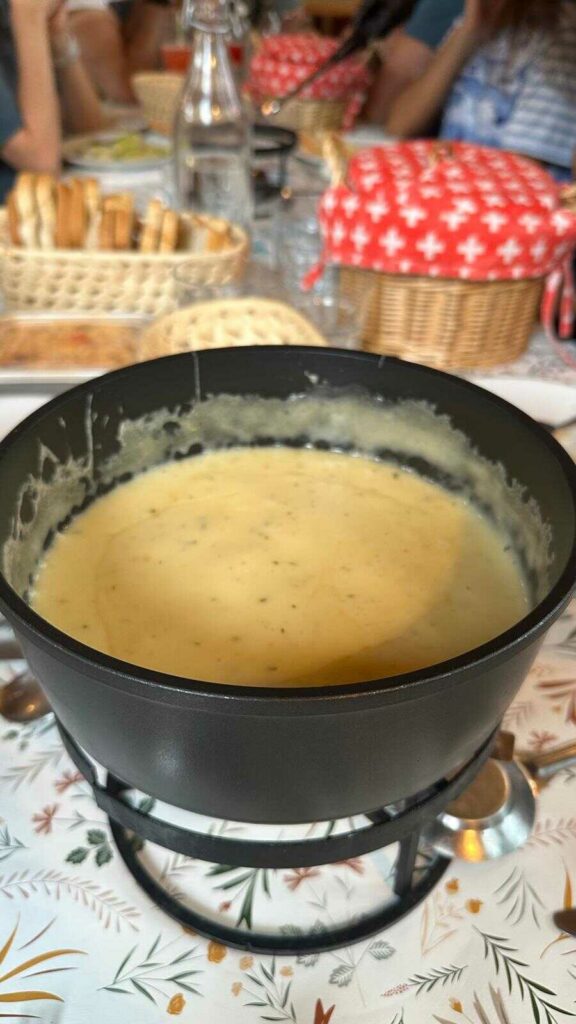
The bathrooms are spacious and modern, with unlimited hot water. After two days of hiking, that’s appreciated. The kitchen highlights regional, seasonal produce (Bon Abri is known for its excellent fondue), and the 50-seat common room creates a real atmosphere in the evening.
Price: it depends on what you choose. The large 18-bed dorm is 34 CHF, the smaller 6-bed dorm is 44 CHF, double rooms start at 55 CHF. Add dinner (25 CHF) and breakfast (12 CHF). The packed lunch is 14 CHF. Good news: they accept both euros and Swiss francs.
My take: it’s comfortable, clean, well-run. Nothing extraordinary setting-wise since you’re at the bottom of the valley, but after a big stage, a real bed and unlimited showers, you’re not about to complain.
La Fouly, in an Airbnb (Switzerland)
Our Day 3, 20 km from Champex.
This one’s our departure from the rule. We couldn’t find an available refuge in La Fouly, so we switched to an Airbnb. And honestly, it turned out to be a very pleasant surprise right in the middle of the trek: being able to do a proper load of laundry, spread out your things, and cook something for yourself really sets you right again.
It’s an option worth keeping in mind, especially in valley-floor villages like La Fouly, Champex, or Les Contamines. When the refuges are fully booked, check the rentals. It’s not the refuge spirit, but it can save your itinerary.
My take: if you’re in a group of 3 or 4, it can even work out cheaper than four half-board stays.
Rifugio Giorgio Bertone (2,000 m, Courmayeur, Italy)
Our Day 4, 25 km from La Fouly, crossing the Grand Col Ferret.
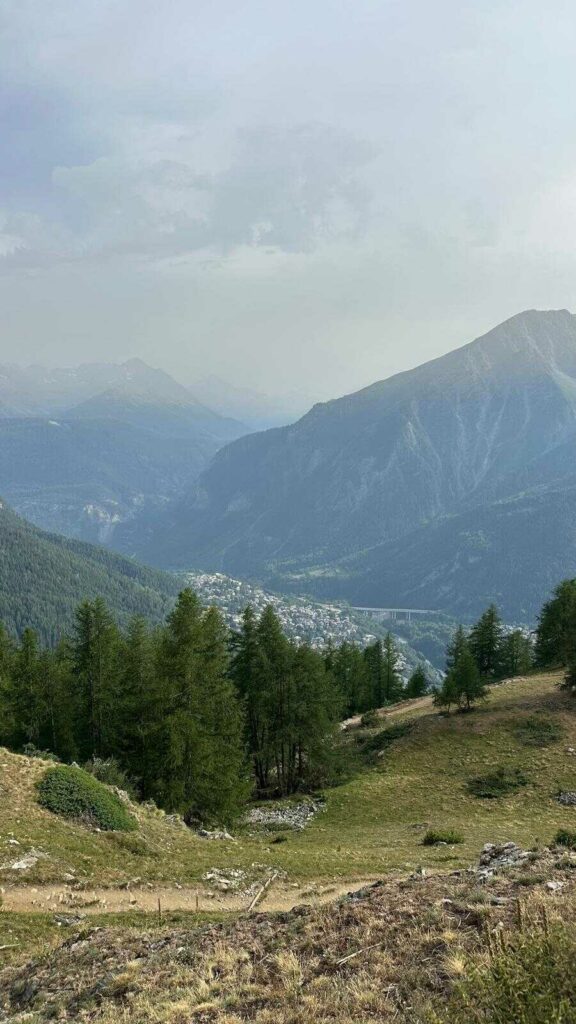
Refuge de Bertone is a TMB classic, and it earns that reputation. Built in 1982 in memory of the mountaineer Giorgio Bertone, who died in a plane accident at Mont Blanc du Tacul in 1977, it perches on Mont de la Saxe above Courmayeur. The head-on view of the massif from the terrace is simply one of the finest on the whole tour.
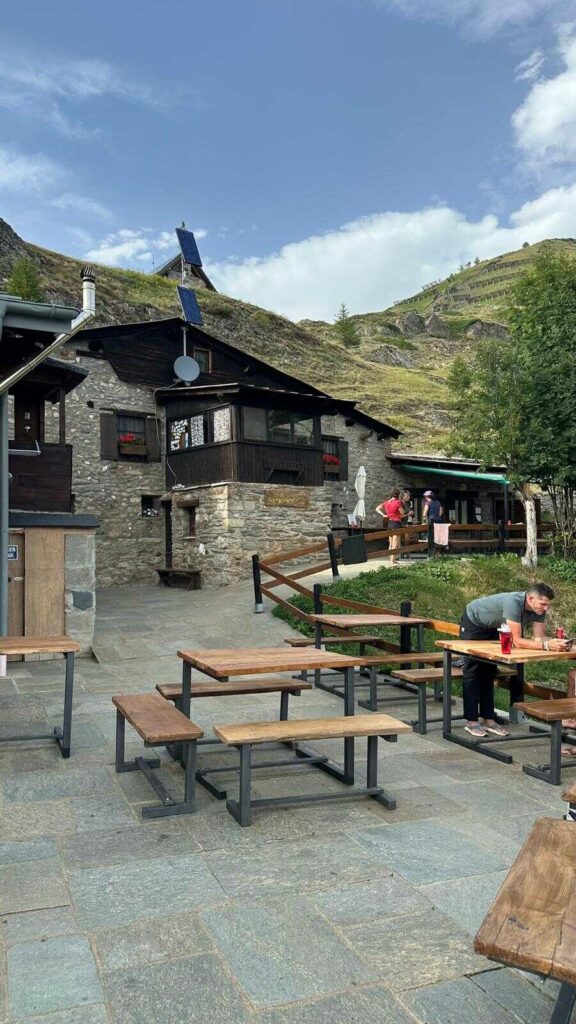
Refuge de Bertone is organized around two buildings: the lower one with reception, the restaurant, and the terrace, and the upper one with the dorms. 60 beds spread across dorms of 12 to 16.
Price: 70 € for half-board in a dorm, 12 € for the packed lunch, 1 € tourist tax.
Note: cash only. Get your cash ready before heading up, as there’s obviously no ATM up there. Hot showers cost extra.
My take: dinner is good, the setting is superb. Breakfast, on the other hand, is fairly light. That’s the complaint that comes up most often among hikers, and I agree with it. It’s still one of my most memorable nights on the tour, for the view.
Refuge Robert Blanc (2,750 m, Vallée des Glaciers, France)
Our Day 5, and by far the biggest stage: 29.5 km and 2,500 m of elevation gain.
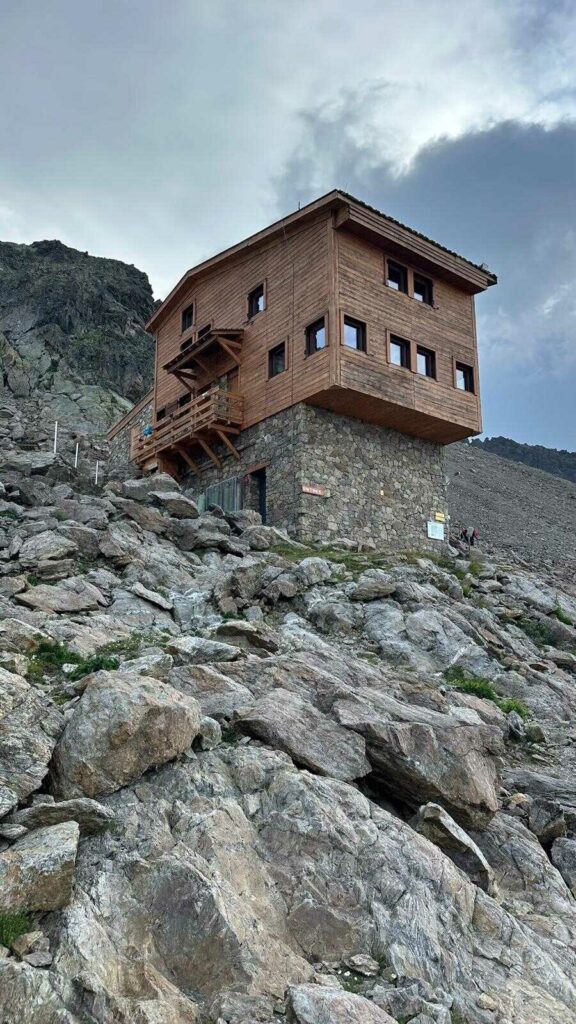
This one’s my favorite, and also the most committing. One important note: Robert Blanc isn’t on the main TMB route but on a variant. You won’t stumble onto it by accident. You have to want it.
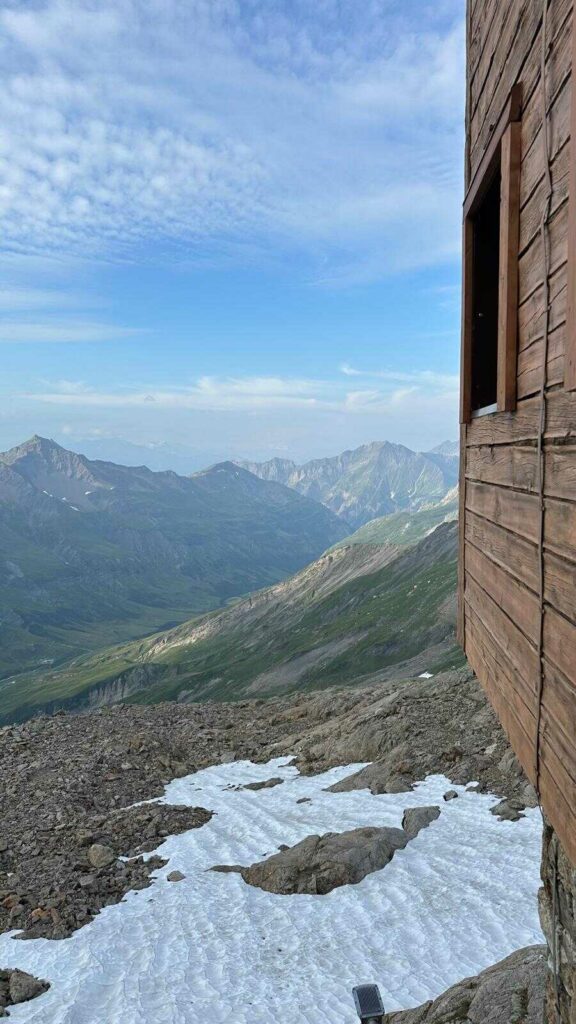
At 2,750 m, it’s the highest of our nights, and the scenery is entirely mineral. The refuge overlooks the Vallée des Glaciers, at the foot of the Aiguille des Glaciers and Mont Tondu, with views over the Beaufortain, the Vanoise, and the Écrins. Built in 1981, it belongs to the town of Bourg-Saint-Maurice.
What struck me was their approach to food. The cheese comes straight from the Vallée des Glaciers, the meat and charcuterie from a free-range farm in Venthon, the beer from the Névés microbrewery in Bourg-Saint-Maurice. The bread is sourdough, organic, and made on-site every day. The pantry is mostly organic and bulk. As they put it themselves: no butter portions or tea bags at Robert Blanc. After climbing 2,500 m of elevation in a day, eating something like that changes everything.
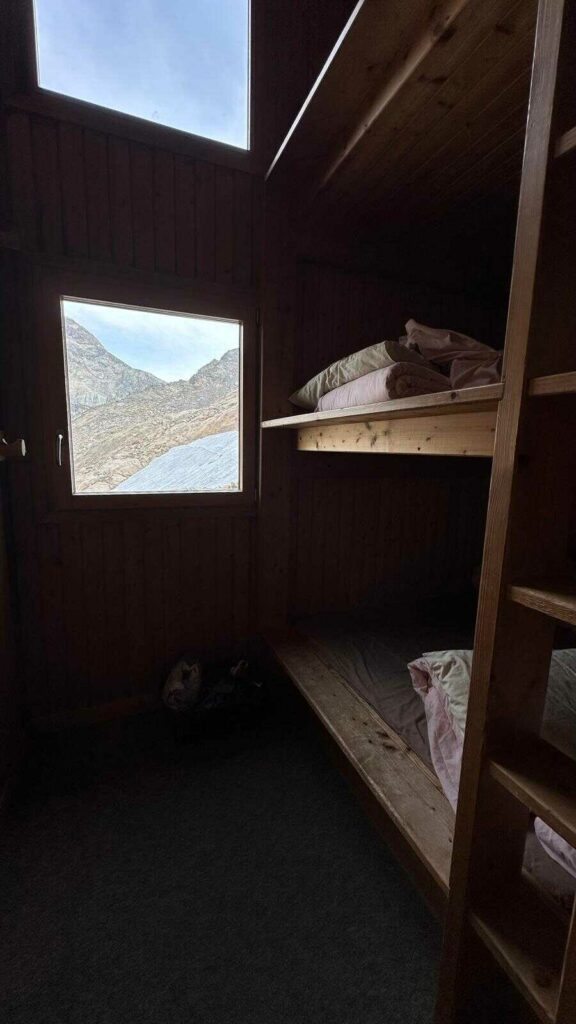
Good to know: there’s no shower. None. This is proudly high-mountain, deliberately simple. The refuge is staffed from early June to September 15th.
My take: this is the kind of place where you understand why you’re doing this. Total disconnection, no signal, a crazy silence. If you can fit this variant into your itinerary, do it.
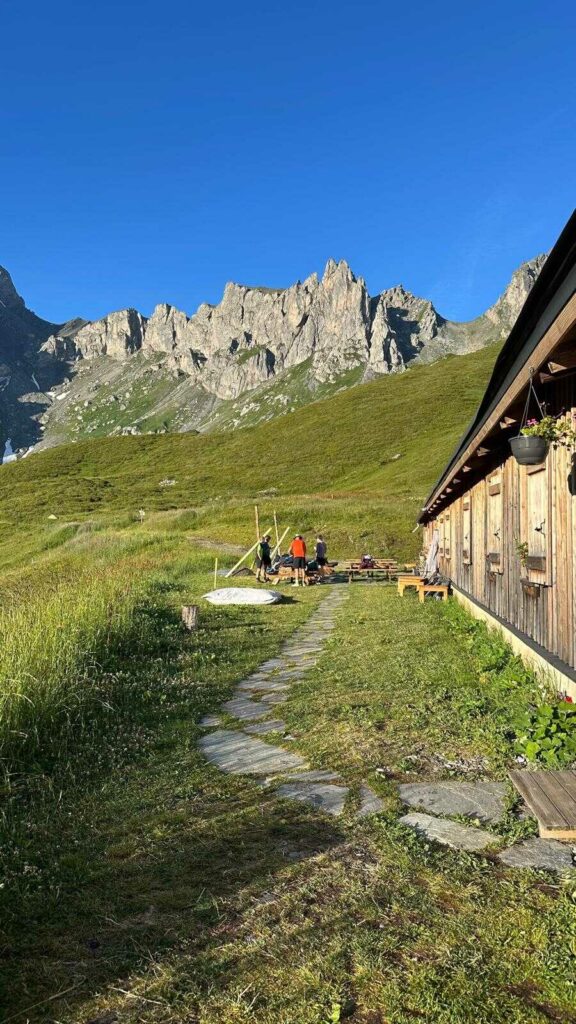
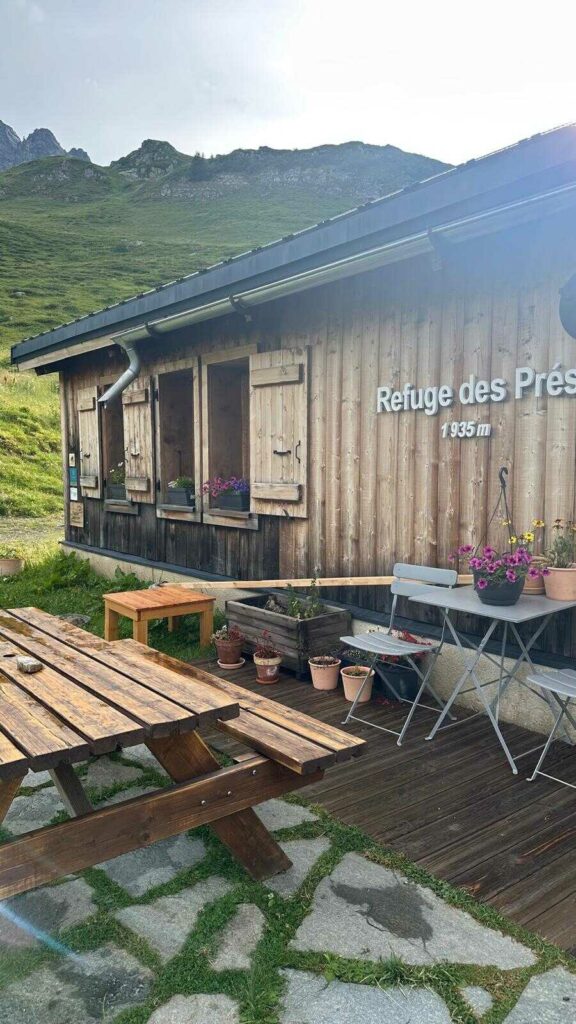
Refuge des Prés (1,935 m, Les Contamines-Montjoie, France)
Our Day 6, 20 km from Robert Blanc.
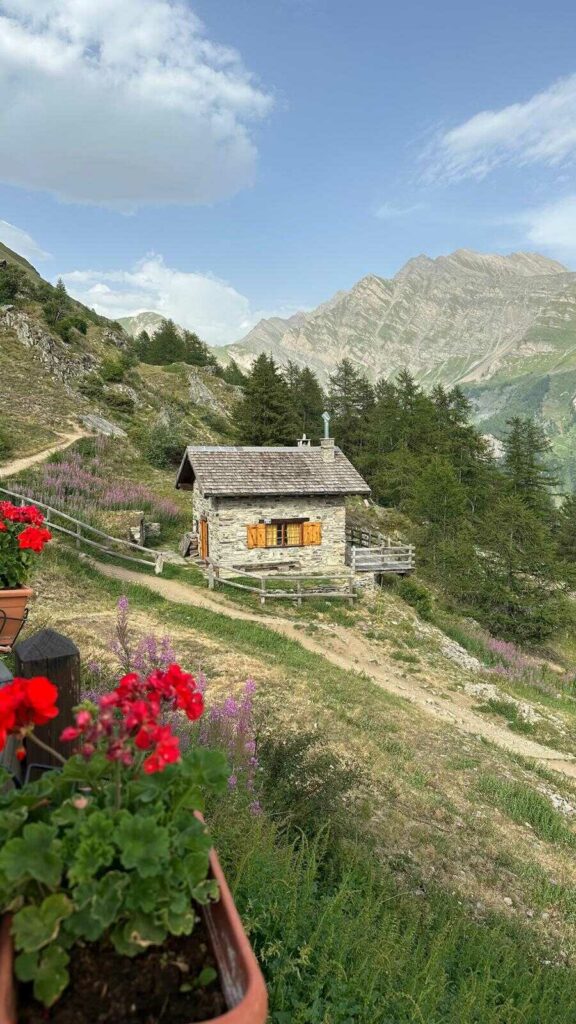
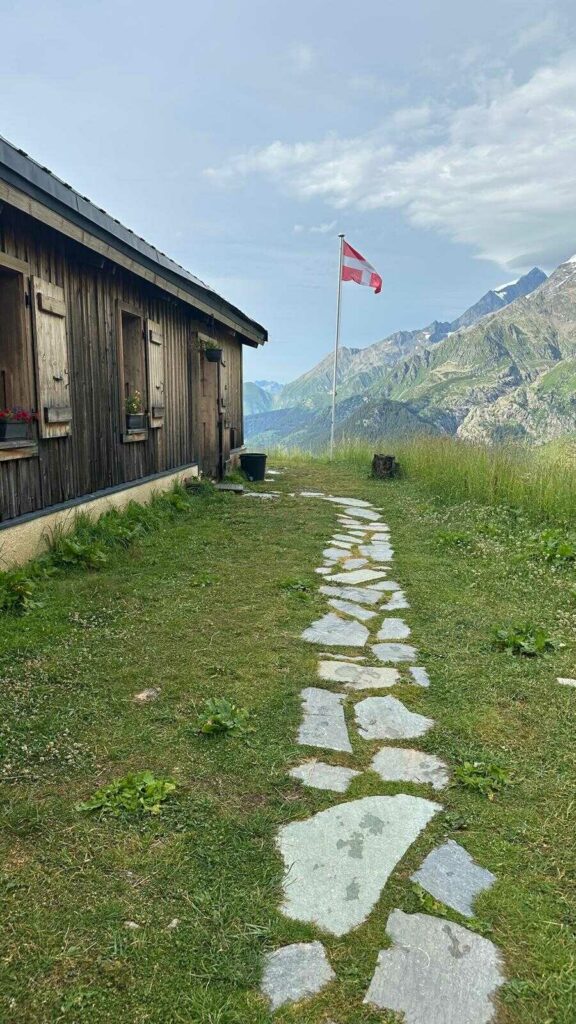
Big surprise, this one: I’d already discovered it a few years back, and it’s just as lovely now. It’s a former alpine chalet fully rebuilt in 2021, so everything is new and thoughtfully designed. 30 beds spread across 7 small 4-person wooden dorms, plus one 2-person dorm. Compared to a 16-bed dorm, that’s pure luxury.
It sits facing the Mont Blanc massif, at the foot of the Tête de la Cicle, right in the heart of the Réserve Naturelle des Contamines-Montjoie, one of the largest in Haute-Savoie at 5,500 hectares, created in 1979.
My take: the small 4-person dorms radically change the quality of your sleep. If you’re the type who sleeps badly in refuges because of the resident snorer (spoiler: there’s always one), put this one at the very top of your list. You can book it directly on their website.
Refuge du Fioux (1,505 m, Saint-Gervais-les-Bains, France)
Our Day 7, 24 km from Les Prés.
A former alpine farm renovated in the ’90s, set in a quiet spot above Bionnassay. Only 22 beds, so again a family-style atmosphere. The panoramic terrace looks out onto Mont Joly, the Bionnassay glacier, and the Dôme du Goûter.
Price: starting at 45 € for half-board, making it one of the most affordable on the route.
The rules are precise and worth knowing: check-in between 3pm and 6:30pm, dinner at 7pm, breakfast from 6:30 to 7am, departure before 8:15am. No kitchenette. Sleeping bag liner mandatory (disposable ones available for 3 € on-site if you forgot yours). No contactless payment, bring cash. The packed lunch must be ordered by the evening before at the latest. And bivouacking is no longer allowed there.
My take: simple, authentic, no frills, and excellent value for money. It’s the kind of quiet stage that’s perfect for the second-to-last night, right when you start to feel the end approaching.
Other Tour du Mont Blanc refuges worth knowing about
We didn’t sleep in these ones, since our direction of travel and our stages took us elsewhere, but they’re the essentials of the classic route, and you’re bound to run into them in your research.
Rifugio Walter Bonatti (2,025 m, Italy). Probably the most famous on the TMB. Opened in 1998, it sits at the foot of the Grandes Jorasses facing the Fréboudze glacier, with a panorama stretching from the Col Ferret to the Col de la Seigne. Sleeping bag liner mandatory. Dogs are allowed but only in 2-bed rooms. Booking is by form or email, directly with the refuge.
Rifugio Elena (2,062 m, Italy). The last refuge before crossing the Grand Col Ferret into Switzerland. About forty beds, with views of Mont Dolent and the border glaciers. Credit cards accepted, which isn’t that common. Bivouacking not allowed. It has its own booking platform.
Refuge de la Croix du Bonhomme (2,443 m, France). One of the highest on the French side, run by the FFCAM, with up to 109 beds at peak season, so the dinnertime buzz is part of the experience. One thing hikers often flag: the showers don’t open until 5pm, so if you arrive early, you wait and then you queue.
Rifugio Elisabetta (2,195 m, Italy). In the Val Veny at the foot of the Col de la Seigne, the first Italian stage after the border. Booking by email or form, since it’s not on the centralized platform.
Refuge des Mottets (1,864 m, France). Located in the Vallée des Glaciers at the foot of the Aiguille des Glaciers and the Col de la Seigne, on the GR TMB route. It’s a former cattle-alpine chalet renovated in 2010, with a very family-friendly atmosphere. It comes up often in 4- and 7-day itineraries.
Rifugio Maison Vieille (1,956 m, Italy). Between Col Chécrouit and Courmayeur. Its distinctive feature is cooking done on the Losa, a fire-heated stone slab. Polenta, charcuterie, cheeses, Aosta wines. The atmosphere is said to be very lively.
Refuge de Nant Borrant and Refuge de la Balme (France). Two classic stops on the climb toward the Col du Bonhomme from Les Contamines, smaller and cozier than the big high-altitude refuges. Nant Borrant runs around 40 € for half-board, making it one of the most accessible options.
Tour du Mont Blanc Refuges Map: Accommodations by Sector
To help you picture where everything is, here are the main TMB accommodations in order along the classic route (counterclockwise from Les Houches). This is the framework you’ll use to build your itinerary.
| Sector | Country | Main accommodations |
|---|---|---|
| Les Houches / Bionnassay | France | Gîte Michel Fagot, Auberge de Bionnassay, Refuge du Fioux, Auberge du Truc, Refuge de Miage |
| Les Contamines | France | Gîte Le Pontet, Refuge de Nant Borrant, Refuge de la Balme, Refuge des Prés, Refuge La Roselette |
| Col du Bonhomme / Les Chapieux | France | Refuge de la Croix du Bonhomme, Refuge des Mottets, Refuge Robert Blanc (variant) |
| Val Veny / Courmayeur | Italy | Rifugio Elisabetta, Cabane du Combal, Rifugio Maison Vieille, Rifugio Bertone |
| Italian Val Ferret | Italy | Rifugio Walter Bonatti, Hôtel Chalet Val Ferret, Rifugio Elena |
| Swiss Val Ferret | Switzerland | Gîte de La Fouly, Auberge des Glaciers, Chalet Le Dolent |
| Champex / Trient | Switzerland | Auberge Gîte Bon Abri, Relais d’Arpette, Refuge Le Peuty, Auberge La Grande Ourse, Hôtel du Col de la Forclaz |
| Chamonix Valley | France | Écuries de Charamillon, Auberge de la Boërne, Refuge du Lac Blanc, Refuge Bellachat |
If you want an interactive Tour du Mont Blanc refuges map, one is available directly on montourdumontblanc.com, with walking times between each accommodation. It’s the handiest tool for mapping out your stages once you know how many days you’re doing.
Our tips for a good night’s stay in a refuge
A few things we learned along the way that make a real difference over 7 or 8 nights.
- Earplugs are not optional. In a 16-bed dorm, statistically you’ll have at least one competition-grade snorer. It’s basically math. Bring a pair, and even a spare in case you lose one.
- Pack your bag for the next day the night before. Departures happen early and in the dark, and rummaging through your bag at 6am while waking everyone up isn’t done. Lay out the day’s things, your headlamp, and your toiletries before you go to bed.
- Dry your gear as soon as you arrive. Many refuges have a drying room. That’s the first thing to do on arrival, before the shower, before the beer. Otherwise you leave the next morning with a damp t-shirt, and over 8 days that gets unpleasant fast.
- Order your packed lunch the evening before. Every time. Between the high-altitude refuges and the passes, you can easily walk 6 hours without crossing a single supply point. Budget 12 to 14 €; it’s lighter and often cheaper than carrying your own food up from the valley.
- Carry cash in small bills. I’ll say it again because it’s really the classic trap: several refuges don’t take cards, and ATMs are only found in the valleys.
- Flag any dietary needs when you book. Vegetarian, allergy, intolerance: refuges are generally happy to accommodate, but they cook in bulk for everyone, so they need to know in advance, not the evening you show up.
Tour du Mont Blanc refuges: FAQ
Is the Tour du Mont Blanc a hut-to-hut trek?
Yes, entirely. There’s no need to carry a tent or food: you walk from one refuge (or hut) to the next, and each one takes care of dinner, breakfast, and a bed for the night. That’s exactly what makes Tour du Mont Blanc huts the main thing to plan around, more than the daily distances themselves.
How do you book Tour du Mont Blanc refuges?
Mostly through the centralized platform montourdumontblanc.com, where bookings open each fall for the following summer. A handful of independent refuges (Bonatti, Elisabetta, Bellachat, among others) take reservations by email or their own form instead, so expect to juggle two or three different channels to lock in a full itinerary. See the booking section above for the details.
How do you book huts for the Tour du Mont Blanc?
Same process, just a different word for the same buildings. Whether a site calls them “refuges” or “huts,” booking works the same way: mostly through montourdumontblanc.com, with a few independent ones handled directly by email or their own website.
Are dogs allowed in Tour du Mont Blanc refuges?
Some allow them, like Bonatti, but only in 2-bed rooms. The real issue isn’t the refuge, it’s the route: the Aiguilles Rouges nature reserve strictly bans dogs, even on a leash. That’s why our dog Rhéa stayed home.
Do you need a sleeping bag for TMB refuges?
No, a sleeping bag liner is enough, and it’s mandatory in nearly all refuges. Blankets and pillows are provided. A full sleeping bag would just be unnecessary weight.
Can you do the Tour du Mont Blanc without booking refuges?
In theory, yes; in practice, it’s very risky in July-August. You risk having to take a taxi down to the valley to find a bed, which completely throws off your itinerary. Outside peak season (June or September) it’s more doable, but some refuges are closed then.
What are the best refuges on the Tour du Mont Blanc?
Depends what you’re after. For the view, Bertone and Bonatti are hard to beat. For an authentic high-mountain atmosphere, Robert Blanc. For comfort and sleep quality, Refuge des Prés with its small 4-person dorms. For value for money, Refuge du Fioux.
How much does a night in a refuge cost on the TMB?
Between 50 and 70 € for half-board in France, 50 to 80 € in Italy, and 60 to 100 CHF in Switzerland. Add 10 to 14 € a day if you take the packed lunch.
Do you need to book Tour du Mont Blanc refuges in advance?
Yes, absolutely. Summer bookings open between late September and mid-October on montourdumontblanc.com, and the most in-demand refuges sell out within days, sometimes within hours. Aim for 3 to 6 months ahead at a minimum.
Where can I find a map of Tour du Mont Blanc refuges?
montourdumontblanc.com has an interactive one with walking times between each accommodation. You’ll also find a sector-by-sector breakdown earlier in this article to help you visualize the classic route before you start booking.
So there you have it, that’s everything. The real advice I’d give you over coffee: block off your booking evening in October, plan your itinerary beforehand, and accept that the refuges will dictate part of your route. It’s frustrating in the moment, but it’s also what led us to discover Robert Blanc and Refuge des Prés, two places we’d never have found otherwise. If you have questions about a specific refuge, come ask me in the comments or on Instagram, I always answer.